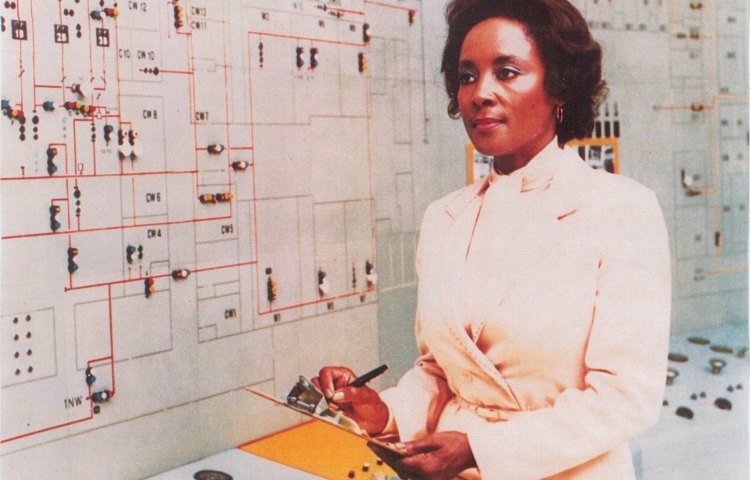
Before computers were machines, they were people—and NASA couldn’t have made it to space without its pool of “human computers.” These pioneering female mathematicians broke barriers for both women and people of color, giving a more diverse face to NASA’s early boys’ club.
By the time NASA got its name in 1958, it had already been in existence for 46 years. Its predecessor was the National Advisory Committee for Aeronautics, and it was deeply rooted in all-male pilot culture—a culture that initially had little room for women. That changed in 1922, when a woman named Pearl Young came to work at the Langley Instrument Research Laboratory. At the time, there were only 21 female physicists in the United States, most of them teachers. Young marked a new beginning for the agency, which began to hire women mathematicians in the 1930s.
Pearl Young (NASA)
As the agency expanded its tests, it had to crunch more and more data, and what started as a small pool of “human computers” started to grow. By 1942, the mathematics pool was so appreciated that “the engineers [admitted] themselves that the girl computers do the work more rapidly and accurately than they could.”
But there was still a barrier at NACA—race. Though Langley began to recruit black women to join the human computer pool as early as the 1940s, they were initially segregated from their white counterparts. But in 1953, a black woman named Katherine Johnson joined the segregated computing pool. Her talent turned heads, and when the all-male flight research team needed a fill-in, she was assigned to help. It ended up being a permanent assignment, and Johnson’s calculations of space shot trajectories would end up being used for missions like Apollo 11.
Katherine Johnson (NASA via Katherine Johnson)
Johnson wasn’t the only black woman who got her start in NACA’s computer pool. Annie Easley joined the pool when her pharmaceutical education stalled. When NACA became NASA, she got promoted to a position as a math technician. Though the agency paid for her male counterparts to get advanced degrees in math, she had to self-fund her own continuing education. And though she faced a sometimes rocky road within the agency, she eventually became a computer programmer whose work has influenced everything from solar technology to the Centaur rocket.
Annie Easley (NASA Science and Engineering Newsletter (Fagowees))
When asked if there was a more accepting environment at NACA, Easley had this to say:
It’s difficult to say what would have been if you weren’t really there. But I think even with the federal government out at NACA, women were placed in computing division or even—I remember someone, I think, who had a degree in accounting, who may have been put in clerical work. Remember, we’re still dealing with people who have certain perceptions as to where women ought to be. Nothing was given to minorities or women. It took some fighting to get that equal opportunity and we’re still fighting today.