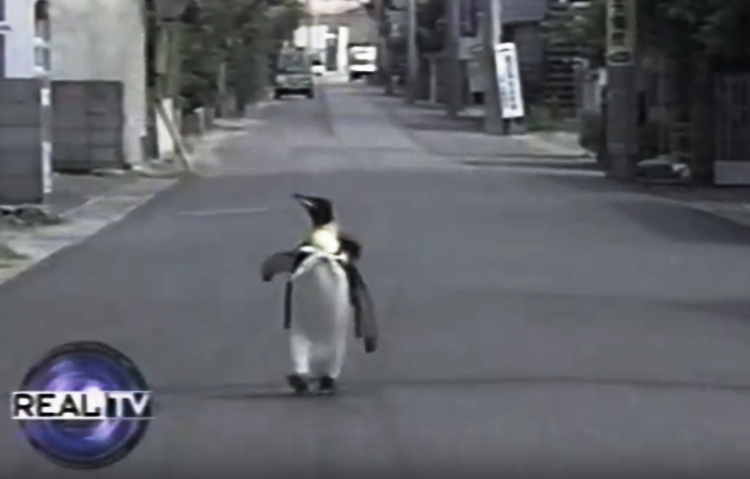
Back in 1996, the astounding footage clip show that was RealTV (1996-2001) aired a segment that managed to capture the hearts and minds of the world: the story of Lala the King Penguin. The show introduces Lala as the pet of a small-town Japanese family, showing the bird’s intrepid journeys into town (while wearing an adorable penguin-shaped backpack) in search of mackerel and sardines at the local fish shop and his pit stops in neighbors’ houses for a hose down. It was an early example of what would now be viral internet footage. But the clip was also just bad TV reporting, as it left the entire world wondering how the hell Lala made it to Japan and whether we could all own absolutely adorable penguins, too. Thankfully, we now have some answers.
Some reporting on Lala mistakenly claims that Yukio, the head of the Nishimoto family with whom Lala lives, caught the bird while on a fishing trip around the time of the clip. This account is false, but not totally baseless. About ten years before the 1996 clip, Yukio was apparently admiring a stuffed penguin that a fisherman friend, who trawled for tuna between South Africa and Australia, had acquired on a recent trip. When the friend went back out, he pulled up a net with an injured penguin stuck inside. Most King Penguins live just above the Antarctic, but a few “vagrant” birds are known to ply the waters around South Africa and Australia, so this wasn’t exactly unheard of. Rather than toss the bird back to be consumed by sharks, he decided to bring it back to Yukio, binding its ankles in wire for three months before returning to meet his friend in the town of Shibushi on the southern end of the Japanese island of Kyushu. He handed Lala over to Yukio saying he could stuff the bird when it died, making his own memento.
But Lala quickly grew on Yukio and his wife—so much so that the patriarch built a refrigerated room for the bird after he refused to go back into the waters when Yukio tried to release him. He set up a system with local merchants to provide for Lala, and gave him a mirror so he wouldn’t feel lonely, as social penguins are prone to do when isolated. And even after the RealTV clip brought Lala to popular attention, Yukio refused all offers to sell the penguin off to new owners.
Anyone planning to visit Shibushi today to visit Lala shouldn’t move too fast, though. Lala’s likely dead. In 1996, Lala was about 14 years old and had mold in his lungs. As King penguins live about to 30 years in their natural habitat, it’s likely that Lala, 19 years after that video was aired, walks this earth no more (although reports form 2011 did claim that the penguin was alive then and had survived an earthquake in the region). Yet we have no definitive word on Lala’s fate, save that Yukio insisted in reports that he would not stuff the penguin’s corpse, but give it a proper funeral.
And folks planning to go out and buy their own penguin after hearing about Lala ought to hold up as well. Despite public interest in penguin pets by celebrities like Simon Cowell and hosts of sites claiming that they’re increasingly common pets and offering to connect you to breeders, the birds are considered exotic pets and are thus controlled-to-banned by most nations, including the United States.
Even if you managed to get a special permit to raise a penguin abroad, you probably wouldn’t be able to afford it. Building an artificial habitat can cost between $6,000 and $10,000, while buying a penguin can cost $1,000, and feeding one can cost well over $1,000 a year (Lala’s 1996 fish bill ran about $830 annually, not to speak of his vital water and vitamins). And that’s just the costs for one penguin—it’s borderline cruelty to keep these group animals in isolation, so if you wanted to be a kind owner of a happy penguin you’d need to buy multiple birds in one go.
If you really want to connect with and support a penguin, your best bet might be to “adopt” one at a zoo. (There’re about 200 penguins in North American institutes.) This one-time expenditure, usually of a few hundred bucks, will allow you certain visitation rights in most instances, while keeping zoo programs at their best and allowing trained professionals to care for penguins. That’s the approach Norway took with the world’s second most famous penguin, Nils Olav.
In 1961, while in Edinburgh for a military shindig, Lieutenant Nils Egelien of the Royal Norwegian Guard grew attached to a bird in the local zoo. As it turns out, these birds descended from a flock granted to Scotland in 1913, at the zoo’s opening, by a Norwegian man named Christian Salvesen. So Egelien’s sense of cultural affinity made sense. In 1972, his unit returned and adopted the bird as its mascot, naming it for Nils and Norway’s then-King Olav V, who ruled from 1957 to 1991. Nils Olav became a lance corporal, the lowest non-commissioned officer, but in subsequent visits by the Guard was promoted up and up until he was knighted by King Harald V as Sir Nils Olav, Colonel-in-Chief of the Norwegian Army, at the Edinburgh Zoo (wearing an insignia on his flipper) in 2008. A statue of the bird now stands outside the Royal Norwegian Guard compound just outside of Oslo, a far more successful patronage and love for the birds than the Norwegian Nature Protection Society’s failed bid to release penguins in the Norwegian wilderness in 1936—these birds vanished, presumably dead, in the 1940s.
Unfortunately, Nils Olav died well before Lala even came to Japan in the 1980s. But that’s another benefit of zoo adoptions: conceptual immortality. A baby penguin became the next Nils Olav and sits in the Edinburgh zoo to this day. So if you are inclined to visit the once and future military mascot, it is a more accessible and realistic penguin pet than Lala ever was. RIP Lala!