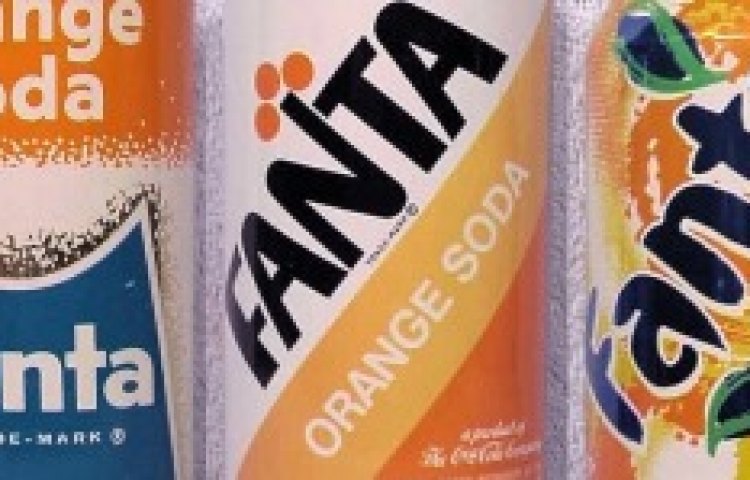
There’s nothing quite like the taste of Fanta to quench the thirst of evildoers during wartime. Some believe that may as well be the slogan for the tongue-staining orange drink: Fanta emerged from warring Germany in the 1940s, and apparently was created specifically to sate the Nazi thirst. I myself hadn’t heard of this association between the Third Reich and my all-time favorite soda—until recently, when I found myself in Berlin.
Wandering through its streets, past the restored Reichstag building that Hitler (allegedly) had set on fire, and the Gestapo’s former headquarters, I came across the tale of Max Keith, the German who popularized Fanta and supposedly made the Nazis his target market. “When you drink Fanta Orange, that’s the Nazi drink,” says Michael Moore emphatically, in this documentary clip. Everywhere, I began to see the soda—most shockingly, I felt, in the café of Berlin’s Jewish Museum. (‘What on earth was it doing there? It is the Nazi drink!’ I shrieked in my head.) Well, it turns out the tale is a little more nuanced than that.
It begins with Coca-Cola, Fanta’s original maker. Coca-Cola had a factory in Germany, but like many of its European operations, these were deeply threatened by the impending war, which made the trade of ingredients tricky. When Ray Powers, the company’s American operator on the ground in Germany, died in an accident, his position was handed to the German-born Max Keith. Suddenly, this man was awarded a commercial empire—but one that could, ironically, no longer make Coke.
The syrup that makes Coca-Cola what it is was no longer so easy to ship from the United States to wartime Nazi Germany. And so Keith had to come up with another plan, to keep Coca-Cola’s numerous German bottling plants alive. He looked to the ingredients at his disposal, (a bunch of weird things we’ll get to in a moment) and challenged his employees with a contest to come up with a name for a new drink, encouraging them to use their imaginations. The German translation of ‘imagination’, as it turns out, is fantasie, and at the utterance of this brilliant word, the brainstorming session ended and the drink’s name was shortened to the ‘Fanta’ that we know and love today.
Yet, the highlighter-orange fizz we’re familiar with is, in taste, quite a departure from the ancestral drink. It’s hard to know for sure what that version tasted like, but it’s been described as “light-colored beverage that resembled ginger ale.” Known mostly for its citrus-themed flavor nowadays, Fanta back then was flavored with any fruits the recipe masters could get their hands on. Some of the odder additives, flavorings, and sweeteners included by products from other food and drink plants, like whey powder from cheese factories, bits of apple fiber from cider presses, and beet sugars once the trade of the sweetener saccharin had dried up in 1941. And with all of that stirred in, there’s no telling what color Fanta might have been.
Not everybody drank it, either: lots of the Fanta sold during wartime in Germany was upended into cooking pots to sweeten and flavor food; a suitable substitute when the usual flavorings were a luxury. (This trend seemingly lives on in Fantakuchen—Fanta cake—today in Germany: the recipe requires that one-and-a-half cups of orange soda are glugged into the mix.)
But commercial rescue, creative names, and weird recipes aside: was Fanta made for Nazis, and was Max Keith himself a Führer follower? In the opinion of many, Keith is likened to Hitler himself. In The Coke Machine, author Michael Blanding writes that Keith was a
six-foot giant with a Hitler-inspired mustache, who distributed Coke at Nazi Youth rallies, advertised on Nazi educational pamphlets, and draped the stage in swastikas at bottler conventions.
Other sources say the man had little choice in Nazi Germany, especially as the devout Keith probably saw the protection of Coca-Cola’s business interests as his primary responsibility.
But towards the end of the war, Keith’s true standing became a little clearer. When the Nazis commanded that he change the name of the company and nationalize Coca-Cola’s operations to make them part of the Nazi state, Keith resisted—even though it placed his life under threat. After the war, an investigator for Coca-Cola concluded that Keith hadn’t been a Nazi at any point. Author Frederick Allen, in his book about Coca-Cola says, “In fact, he…had resisted intense pressure to join the party and had endured hardships as a result.”
So what was Keith? A cynical, savvy businessman, buying time for Coca-Cola and his new drink, or a man with a sturdy moral sense? The truth seems to fall somewhere in between. Does that free Fanta—and Coca-Cola—from the Nazi connection? Not entirely.
Nazis probably did drink Fanta, and Coca-Cola certainly made profits—arguably where it shouldn’t have—during the war. But Fanta wasn’t really made for the Nazis, as is popularly portrayed, nor, apparently, was it controlled by them—thanks to Keith’s determination to keep their hands off his winning fizz. So, to call Fanta the ‘Nazi drink’ is probably to stretch the truth. (I mean, let’s give this guy Keith at least a little cred here.)
In any event, now there are almost 100 flavors of Fanta, and it’s available around the world: that’s a kind of global domination that’s difficult to undo.
Facebook photo: Jeroen Mul