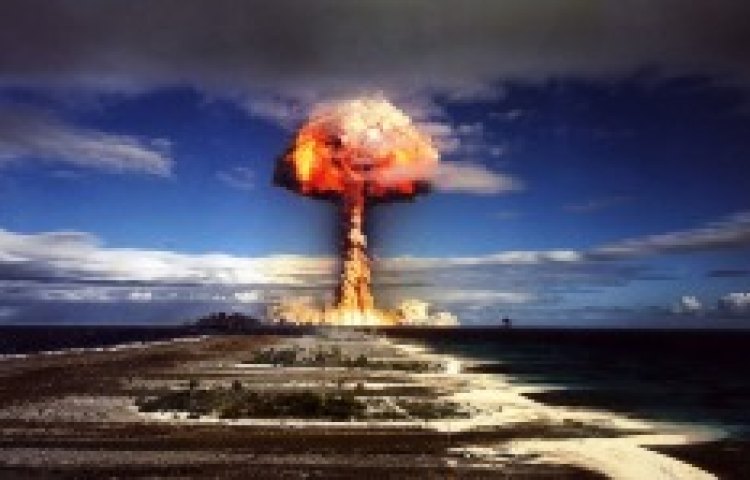
It’s 1952 and you’re stuck in the middle of the Nevada desert surrounded by nuclear physicists. It’s dry. It’s hot. Your team is there to test a new weapon of mass destruction for the military. Any second now the bomb will detonate sending a gigantic mushroom cloud into the sky. Tensions are running high as the anticipation mounts, and boy, you could use a cigarette. But when you reach for your lighter you realize you’ve forgotten it at home.
This is what Ted Taylor, celebrated theoretical physicist and bomb designer, pondered as he waited for his new bomb, the Scorpion, to detonate in 1952. Taylor’s answer: light it off of the explosion, duh.
To do so, Taylor got a hold of a parabolic mirror, a rounded mirror used to collect and focus light sort of like a magnifying glass. After calculating where the light from the blast would be the strongest, used it ignite a Pall Mall. Taylor, in essence, created the world’s first nuclear powered cigarette lighter. Taylor quickly stubbed out and pocketed the cigarette, which he then kept in his desk as a reminder of his feat until he accidentally smoked it while working on another project.
Lighting a cigarette with a nuclear bomb only added to Taylor’s already impressive reputation for thinking outside the box. After his successful detonation of the Scorpion, a compact nuclear bomb, he started work on Project Orion. The new project’s goal was to design a spacecraft that used multiple nuclear explosions as propulsion, basically launching and detonating atom bombs behind a spacecraft to push it forward. The project was scrapped in 1963 with the Partial Nuclear Test Ban Treaty, an agreement to stop nuclear testing unless conducted underground.
After Project Orion, Taylor, the man who once lit a cigarette with a nuclear bomb, had a change of heart. He grew fearful of the weapons he helped create, which drove him to become an outspoken supporter of nuclear disarmament while working at the United States Atomic Energy Commission. While there, he frequently pressed for more support of nuclear non-proliferation in the international community.
Nuclear non-proliferation remained his true passion until his death at the age of 79 due to coronary artery disease.