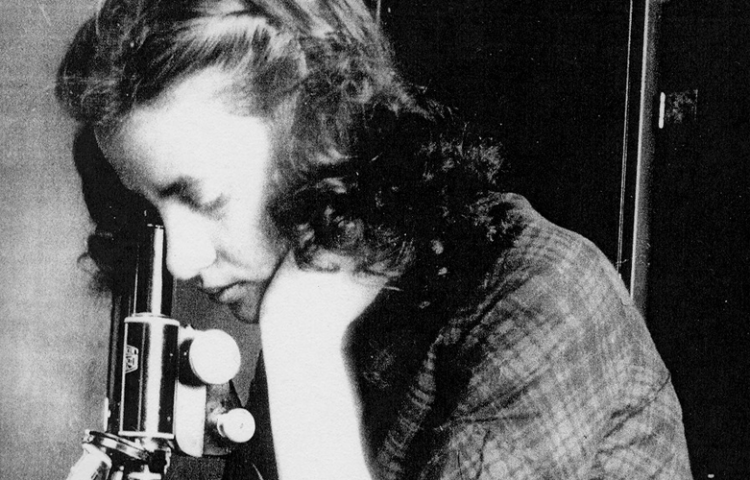
Brilliant scientist marries brilliant scientist. And they all lived happily ever after…except that part where the husband was given a Nobel Prize despite his wife’s contributions. The story of Esther Lederberg is one part misogyny, one part bad luck, one part scientific badassery of legendary proportions.
Esther Zimmer was a child of the Great Depression, living off of bread with tomato juice squeezed on top while her parents struggled to get by. And money wasn’t the only thing in short supply—so was encouragement to women who were interested in the sciences like Esther. Her teachers at Hunter College were “horrified” to learn that she wanted to pursue a scientific degree and tried to persuade her to choose another path. When a colleague at the Carnegie Institute of Washington saw her reading a book on biochemistry, he brushed off her aspirations, scoffing that “women don’t need biochemistry.”
In 1946, Esther married Joshua Lederberg, a brilliant geneticist with a promising career. She followed him to the University of Wisconsin, where she pursued her own graduate education and worked in a lab. In 1951, she noticed some strange streaks on the E. coli mixtures she was using for her experiments. She had just discovered the lambda bacteriophage, which became a model that helps scientists study how viruses work and how genes are regulated and recombined.
Husband and wife joined forces in 1952 and set to work trying to figure out how to make copies of bacterial cultures for accurate, replicable tests. But the team couldn’t figure out how to make the technique work. Then Esther came up with an idea—why not use fabric to stamp the cultures onto plates? She went to a fabric store and selected velvet. It worked and the team had just revolutionized researchers’ ability to study bacterial colonies. As was the custom for married women, her husband was listed as primary researcher on the paper announcing their discovery.
When the Nobel Prize winners for 1958 were announced, Joshua was elated. He had just won the Nobel Prize in Physiology or Medicine for his contributions to genetics. But Esther, who was his partner in the lab and had played a critical role in the discovery of replica plating, was not mentioned or honored at all. At a press conference about the prize, Joshua called his wife “his close associate in the lab,” listing her along with eight other colleagues.
Joshua’s remarks and Esther’s snub had just relegated her to a historical footnote. When she was up for a position at UC Berkeley, where her husband worked, a colleague noted that Esther “has enjoyed the privilege of working with a very famous husband.” Her achievements were constantly questioned and she had to fight to get and retain research positions. But though she was eventually known as a “real legend” in the field of genetics, she is even more known for being overshadowed by the husband she divorced in 1966. “She did pioneering work in genetics, but it was her husband who won the Nobel prize,” read one obituary for Lederberg.