Just take a cursory look at the art from medieval times and you’ll be as convinced as I that people living through the Middle Ages were somewhat humorless. Maybe it’s the stylistically placid faces, or the heavily religious overtones, or the fact that someone is always burning a witch, but I’ve often felt that medieval folks really just didn’t get the joke.
And yet Erik Kwakkel, a medieval book historian from Leiden University in the Netherlands, sees something more. He seeks out medieval cartoons; signs of humor and personality in ancient stately manuscripts. These scribbles and doodles squeezed into the margins, letters, and back pages of old books have become clues about people who, it seems, were very much like us. “If you have a circle, it’s so tempting to put two dots in there and turn it into a smiley face—and people back then did that too!” Kwakkel says.
Doodles down the left side of a text column
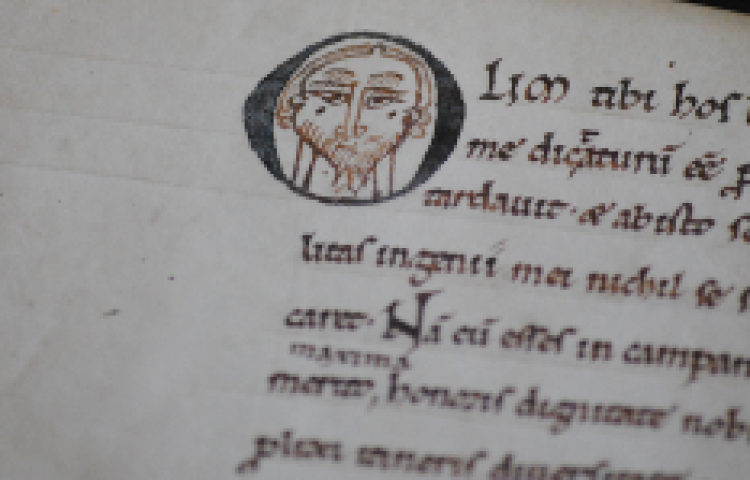
He’s filled his research blog and Tumblr page with medieval graffiti: pictures of faces wedged inside intricate medieval lettering, cartoons sticking their tongues out in an act of unfettered rebellion, a doodle of someone hanging out on the margins and having a smoke, drawings of eagles and owls perching on text, beaming jesters, and even a cartoon of a chubby little guy grinning and holding a flower—which looks as if it might have been drawn yesterday. “I’m not usually interested in the text when I open the manuscript,” Kwakkel says. “For my work I don’t actually read. I look, which is a different thing.”
Faces wedged inside lettering
His cartoon-spying comes as a bonus of his daily work, which involves the study of European book production between the 9th and 16th centuries. He considers how the parchment, binding, and covers were crafted, and how everything hangs together. Because these books come from the era before mass-production ensured world-domination by Harry Potter sequels, every one of the books Kwakkel studies is of course unique, and he sees these unique features in each tome as clues that reveal something about a book’s maker.
For instance, Kwakkel is particularly fascinated by the clues left behind by the scribes who wrote the curlicue texts in medieval manuscripts. “There are two kinds of doodles. There are the great little drawings, which are very popular,” he explains, “but a doodle is also often a ‘pen trial,’ to test if your nib was the same constitution as it was before.” To test new nibs, or to try out a new writing style, scribes had a habit of turning to the empty back pages in a manuscript and scribbling there—creating some of the doodles and cartoons that Kwakkel cherishes now. In fact, he adds, “the oldest literature that we have in Dutch is a poem that was written as a pen trial.”
A cartoon showing two people (arguing?)
Whether the doodles come from scribes or bored students, it’s not always clear that they’re intended to be humorous. “For instance in law manuscripts you often see faces on letters,” Kwakkel says, “faces on letters that stick their tongues out. What does it mean? Did [the drawer] mean to make the reader laugh? I’m not sure.” In other cases, it’s clearer that there was some serious chuckling going on. In one doodle, a gaping hole in some defective parchment was ‘fixed’ by a drawing of a laughing man, the hole becoming his open, cackling mouth. Especially since this appears in a more serious text, “That must be humor,” Kwakkel says.
Medieval pooch
Obviously then, all those placid, disinterested medieval faces are just a front for a bunch of people who really did know how to crack a joke.
All images from University Library Leiden, photographer: Erik Kwakkel