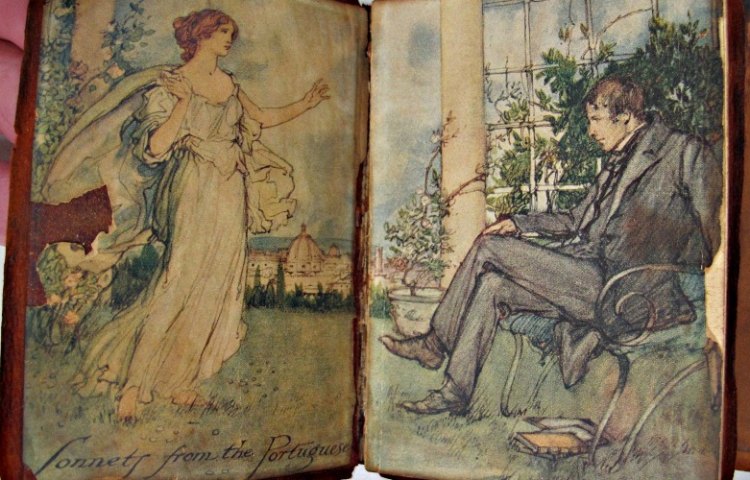
“My elixir,” she called it; a “nameless drug” that calmed her and eased her spirits. “It” wasn’t her poetry, or her famous romance with Robert Browning—morphine was Elizabeth Barrett Browning’s lifelong companion. In fact, Elizabeth Barrett Browning and opium had a love affair. In all of opium’s forms, it may have been the only reason we ever read her poetry to begin with.
How could a studious, high-class Victorian teenager become an opium addict? In nineteenth-century England, it was relatively simple: opium, usually in the form of laudanum or morphine, was widely available and consumed in large quantities (two to three pounds per 1,000 people on average in the 1850s alone). Elizabeth Barrett first encountered the drug as a fourteen-year-old invalid (scientists now believe she suffered from HKPP, a muscle disorder that reduces blood potassium levels and can cause paralysis and weakness). Dependence was swift and long-lasting.
By the time Elizabeth began her vaunted love-affair-by-letter with Robert Browning, he had reason to complain about her dependence. “…that you should care so much about the opium!” she exclaimed in one letter before going on to defend her dependency. “I have been calling it my amreeta draught, my elixir—because the tranquilizing power has been wonderful.” Certainly she did not rely on it for creative inspiration or recreation, only to assist with sleep, body aches, and the agitation of her illness.
But Julia Ward Howe begged to differ. When the American poet (author of “Battle Hymn of the Republic”) gave Elizabeth a book of her poems to read, it was set aside impatiently. “She can’t take rank with poets in the good meaning of the word,” wrote Elizabeth. In retaliation, Howe published a poem entitled “One word more with E.B.B” (a title that mocked a beautiful ode by Robert Browning). It read in part:
I shrink before the nameless draught
That helps to such unearthly things
And if a drug could lift so high,
I would not trust its treacherous wings;Lest, lapsing from them, I should fall,
A weight more dead than stock or stone,—
The warning fate of those who fly
With pinions other than their own.
E.B.B., Howe implied, definitely flew to literary heights with a bit of assistance. Robert Browning was furious at what he saw as slander, but his wife begged to differ. “[It is] perfectly true,” Elizabeth countered, “so far, that life is necessary to writing, & that I should not be alive except by help of my morphine.”
So did Elizabeth Barrett Browning rely on opium for inspiration or not? Perhaps this passage from a letter to her brother holds a clue: “I am writing such poems—allegorical—philosophical—poetical—ethical—synthetically arranged! I am in a fit of writing—could write all day & night—& long to live by myself for 3 months in a forest of chestnuts & cedars, in an hourly succession of poetical paragraphs & morphine draughts.”