Add this to the pile of evidence that perhaps the Victorians weren’t so buttoned up after all—an 1880s upper-crust passion for tattoos.
By the 1880s, tattoos had long been associated with criminals, sailors, the underworld and native peoples. As rulers of the global superpower to end all superpowers, the British aristocracy came into contact with all four, especially during international and colonial travel. When the Prince of Wales got a tattoo of a cross in Jerusalem during his Grand Tour in the 1860s, he was making a religious statement. But when his sons followed, having the tattoos copied and adding some of their own, a fad was born. Suddenly tattoos were popping up all over royals, from Czar Nicholas II to Kaiser Wilhelm. And at some point aristocratic women took the plunge, too.
Image: Czar Nicholas. madamepickwickartblog.com
Spurred by the advent of the tattoo machine and eager to decorate themselves with rare and unique designs, rich women took to the needle. Inscribed on wealthy bodies, these decorations were not for public consumption. In fact, the ways in which the aristocracy concealed their tattoos were as ingenious as the tattoos themselves. The intriguing and gorgeous Jennie Churchill (mother of Winston) was known for her shining bracelets. In 1906, The New York Times confirmed that they covered a tattoo—a “dainty” serpent that encircled her wrist. Other society women covered their tattoos with long sleeves or chose to display their body art only to lovers and friends.
Image: Jennie Churchill and her bracelet. NYPL
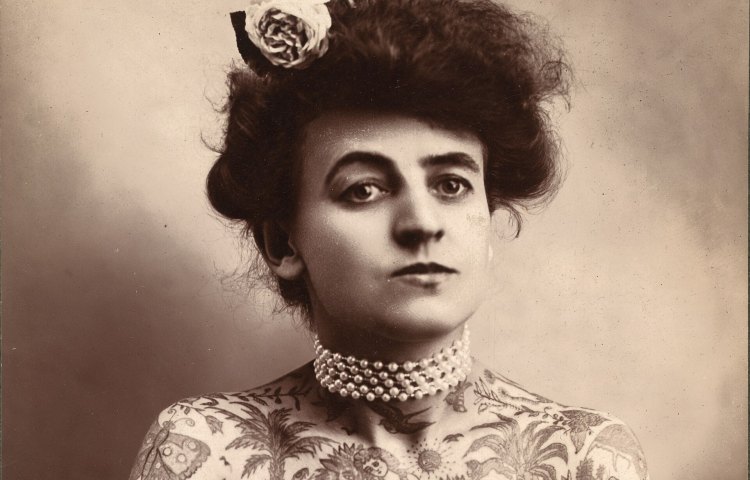
But rich women, sailors and kings weren’t the only people sporting tattoos at the time. The 1880s also marked the arrival of tattooed ladies to the already-active circus and carnival scene in the United States and Britain. These women challenged sexual norms by lifting their skirts to reveal hundreds of tattoos, but tattooed ladies were also noteworthy for their ladylike ways. Nora Hildebrandt was the first of the famous tattooed ladies, touring the United States with P.T. Barnum and serving up sexual titillation tamped down by hints of rape at the hands of the fictitious Indian captors who “forced” her to receive over 300 tattoos. In reality, she was the daughter of a tattoo artist.
Image: Nora Hildebrandt. 1942 reproduction of an Eisenmann cabinet card
Rich ladies may have set trends, but tattooed ones like Hildebrandt, Mlle. Aimee and other sideshow performers broke them. Their popularity and the growing availability of cheap, professional tattoos was the death knell of body art for ladies of the elite. Once tattoos crossed over to the lower classes, the aristocracy lost interest, covered up, and moved on.