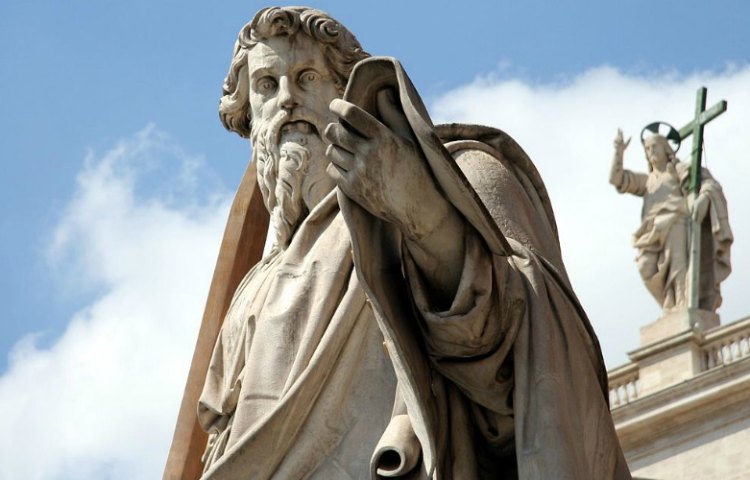
The fifth century saint Augustine of Hippo once said, “There’s no saint without a past, no sinner without a future.” This is a concept we often forget what with saints’ tendencies to serve the poor, go hungry for others, nurse the sick, watch over orphans, care for widows and look real good in a halo. All in all, they seem like models of perfection.
But make no mistake, they are not afraid to throw down.
The following saints, some well known and others not, show that these venerated Christians of the past were remarkably human—and badass. They were smart alecks, had fierce opinions, broke rules, got angry and even threw punches. This is what happens when saints stop being nice and start being real.
Saint Nicholas
St. Nicholas, the 4th century Archbishop of Myra, is known by most of the world today as Santa Claus: the jolly, bearded man who flies around the world once a year to give gifts to good children.
The Santa Claus myth stems from a tale of Nicholas giving three sacks of gold coins to a family who had no money for their young daughters’ dowries. Without the money to pay for their wedding dowries the girls would have most likely led a life of prostitution, which Nicholas couldn’t stand the thought of. The dowries were just the start of St. Nick’s lifelong commitment to helping the poor. Throughout his life, Nicholas gave away large amounts of gold to those in need because being rich brought him no happiness unless he could help others.
It turns out, though, that St. Nick didn’t just dish out presents to good boys and girls or a lump of coal to the bad ones, he also gifted heretics with a swift punch in the mouth.
During a hearing in front of the Ecumenical Council in Nicaea, Arius, the father of Arianism, stood up to proclaim that Jesus Christ was not an infinite being and not the son of God. St. Nick, who was speaking at the time, presumably dropped his microphone, ran down the aisle, grabbed Arius by his beard and, according to legend, gave Arius a jolly ole wallop upside his head.
St. Nick’s outburst landed him in prison where, in the middle of the night, the Holy Family appeared in front of him, undid his bonds and restored his holy dress. Upon seeing what they perceived as a miracle, the other bishops ruled that Nicholas’ actions were righteous and that Arius was a heretic.
Saint Quiteria
Ah, St. Quiteria. What a saucy minx. Not much can be confirmed about this saint except her name, her feast day (May 22) and that she is the patron invoked by Catholics to protect against rabies. Weird. But that doesn’t stop many from speculating about this supposed virgin martyr, which has created multiple stories that are as amazing as they are unbelievable.
The first is the version generally accepted by Catholics: allegedly Quiteria was the daughter of a Galician prince, who ran away from home after her father wanted to force her to marry and renounce her Christian beliefs. Her not-so-princely father sent men after her and when they caught up with her, he had her beheaded for her disobedience and beliefs.
The second version comes from Portugal, where the people are especially devout to her. In this story, Quiteria is one of nine sisters born to a mother who was either ashamed of giving birth to so many daughters at once, suffering from postpartum depression or afraid of what her husband would think, depending on which account you believe. Whatever the reason, she asked her maid to drown them all in the river, but the maid, being the only not totally insane person, instead brought the girls to local women to be cared for.
As adults, the nine sisters all opposed the worship of Roman gods and were brought before their father (a Roman official), who recognized them and decided they would be married to Roman officers. Instead, Quiteria and her sisters escaped to the mountains and launched a guerrilla warfare campaign against the Roman Empire. St. Quiteria was eventually caught and beheaded, but not before being a badass empire-battling feminist.
Saint Moses the Black
Like any real badass, St. Moses the Black had a couple aliases including “the Ethopian.” Prior to becoming the Patron of Africa, Abba Moses of the 4th century was the slave of a government official who expelled him for thievery and possible murder. But before Moses really turned a corner and found the light, he did a bit of soul searching as the leader of a gang of robbers. Big and powerful, it was clear why he ran the group. Ironically, it was his bad ways that led him into the safe arms of a group of a monks while attempting to hide from authorities. In a total Jean Valjean move, Moses gave up his old ways and became a pious Christian.
Still, Moses’ old ways caught up with him, and while alone in his cell, he was attacked by a group of robbers. For a badass like Moses, this was no thing. He rounded them up and brought them to church declaring it was un-Christian to do them harm. The attackers were so in awe of Moses they repented and joined the community.
Moses was eventually ordained a priest and as an old man, he made the ultimate sacrifice. Instead of fleeing, he chose to stay behind when barbarians attacked the monastic valley and he was ultimately killed. When asked why he stayed behind, Moses apparently responded, “Those who take up the sword shall perish by the sword.” Despite his bold bad ways, St. Moses the Black, in the ultimate comeback story, became known as the saint of non-violence.
Saint Lawrence
St. Lawrence is the guy that shows you that saints can be cheeky as well as holy. A deacon in Rome, St. Lawrence met his end under Roman Emperor Valerian in 258 AD after the emperor announced Christian leaders were to be executed. After the pope and several other deacons were killed, Lawrence knew he had limited time before he was was caught too.
Legend has it that because Lawrence was responsible for handing out alms, he distributed everything both he and the church had, selling even relics in order to provide for the widows, orphans and poor the church cared for when he was gone. The prefect of Rome heard about the money being handed out in the community and tried to snag a bit for himself before sending Lawrence to his death. When the prefect summoned him, Lawrence said the church was indeed wealthy and agreed to bring him their wealth in three days after he had a chance to put things in order. Lawrence arrived arrived a few days later, but he didn’t bring the silver, gold and jewels the prefect imagined; instead he brought the scourge of society—the blind, poor, maimed, leprous, widowed and orphaned. “These are the treasures of the church!” Lawrence announced to the authorities.
Not too pleased at Lawrence’s cheeky response, the prefect promised him a painful and slow death. Soon, Lawrence found himself on top of an immense gridiron with hot coals underneath to cook him to death. As he lay on one side, he announced to the guards, “Turn me over. I’m done on this side!” and then right before he died said, “It’s cooked enough now.”
For his cheek to the prefect and guards as he cooked to death, Lawrence has been dubbed the Patron Saint of Comedians. After all, if that’s not an example of laughing in the face of death, we’re not really sure what is.
Saint Peter
St. Peter was kind of a biblical superstar. He was BFFs with Jesus, walked on water and performed miracles. Jesus even decided to give him authority over the church once he was gone.
But in addition to being well-connected, Peter was also rather passionate and impulsive, so when guards came to arrest Jesus, he pulled out a sword and chopped off one of the mens’ ears. Jesus being Jesus, told Peter off for this and healed the man. Then, as Jesus was taken away, Peter pulled the ultimate jerk move and ran away to save his own skin. Not only that, but he denied any association with Jesus. This after only a few hours earlier swearing absolute loyalty to the son of God.
Peter is one of the ultimate examples that saints were not perfect and were not meant to be. Even after that ordeal, Jesus forgave him and he went on to establish the biggest religion in the world. Lesson? Never give up on the halo.