In October 1961, the Kreese family of Long Island, New York took a holiday. Sort of.
The Kreeses—28-year-old Martin, a self-employed electrician, his wife, 25-year-old Judith, and their two small children, Robert, 5, and Martin, 3—spent 151 hours living in nearly plain sight in a fallout shelter in the middle of a mall. According to a contemporary New York Times report, around 40,000 people watched the Kreeses through a big picture window; some even spoke with them through the microphone installed for just that purpose. The family cooked their meals off a hotplate and survived on peanut butter and jelly and crackers. When they emerged, after nearly a week in captivity, Mrs. Kreese said she felt “fit and chipper” and Mr. Kreese called it a “much needed rest” and “quite a change” from their normal vacation. Which was probably not at all how they’d feel if there had been an actual nuclear disaster, but that’s rather beside the point.
In the 1950s and ‘60s, experiments like this one, which was sponsored by the Nassau County Civil Defense Commission, were fairly common; they were efforts both to find out whether people could survive for longish periods of time in confined quarters and to help the general public feel more comfortable about doing so. And it wasn’t just humans: Just two years after the Kreese family’s voluntary imprisonment, two University of Nebraska seniors spent two weeks in an underground bunker in Elkhorn, Nebraska with 35 cows and a bull called “Aristocrat”; boredom was their chief complaint. The cows, however, were fine, and the experiment, a joint project of the Office of Civil Defense, the US Department of Agriculture, and Roberts Dairy Company, was deemed a success.
But then again, this was the height of fallout culture; never again would fallout shelters have as much cultural and governmental credibility as they had in the early Atomic Age. Fallout shelters were distinct from bomb shelters, a shift that largely occurred after the Bikini Atoll hydrogen bomb tests in 1954, when it became clear that firstly, a bomb shelter wouldn’t offer much protection from a blast 1,000 times the size of the bombs that devastated Hiroshima and Nagasaki, and secondly, if the blast didn’t kill you, the radioactive fall out would. So the U.S. government quietly shifted its focus away from bomb shelters to fallout shelters, which were geared towards a longer term confinement. Beginning with the Eisenhower administration, the government encouraged private citizens to build their own fallout shelters in their backyards and basements.
National Museum of American History Smithsonian Institution
“In the Eisenhower era, the government is always talking about self-help, you need to build your own backyard bomb shelters,” explained David Monteyne, professor of architecture in the Faculty of Environmental Design at the University of Calgary and author of Fallout Shelter: Designing for Civil Defense in the Cold War. Discussions in Congress about building government-funded fallout shelters across America never got off the ground, Monteyne said, owing to the massive projected cost—$25 billion, “more than the state highway system.” But after John F. Kennedy came to office in January 1961, the conversation substantively shifted from asking people to build their own shelters, at their own cost, to the government providing shelters using what structures the country already had. “It’s partly political… It’s kind of a change in the discourse that is tied to Republicans versus Democrats.”
In 1961, in the midst of the Berlin crisis, Kennedy appointed the country’s first ever head of civil defense. In 1962, Congress approved $38 million for the survey of the country’s existing structures to determine, based on things like thickness of walls and depth underground, which offered the best protection in the event of a nuclear attack. The Office of Civil Defense teamed up with the American Institute of Architects and relied on architects and architecture students to perform the assessments; they made it around most of the country in three years. Once suitable facilities had been identified, they were stocked with enough first aid supplies, food, and water to last around two weeks – an essentially arbitrarily chosen period of time, given that no one could really predict how long radioactive fallout would remain in an area. The cost of stocking and maintaining the shelters was split between the state and federal governments.
James Vaughan
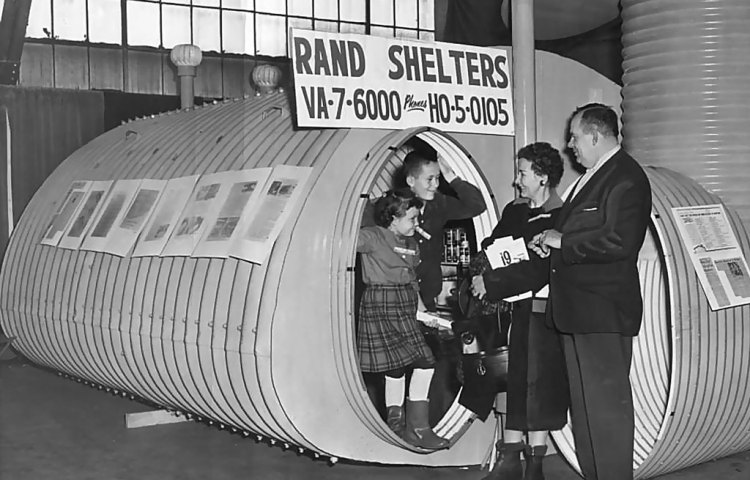
But even as the government discourse shifted away from asking people to build their own shelters and towards a government-run program of fallout shelters, commercial outfits still sold them. Or at least tried to. Because the fact is, not very many people actually bought them.
“They were not that pervasive – but they were certainly in the media and the national imagination,” said Monteyne. Fallout shelters captured the public interest because they were a little bit weird, so talking about them was a nearly surefire way to grab attention, for whatever reason. Case in point, the infamous Miami newlyweds whose August 1959 honeymoon in an 8-foot-by-12-foot steel and concrete bunker 12 feet underground was, covered by LIFE magazine—happily for the bunker builder who sponsored the stunt. Or the property development company in 1962 that tried to sell more of the $38,000 Colonial-style homes they were building at Lido Beach in Long Island by offering concrete-reinforced fallout shelters, built to Civil Defense standards, with each one. Or the rash of Popular Science magazine advertisements and articles instructing readers how to build their very own cheap and cheerful versions.
James Vaughan
So even though there was a lot of talk about private fallout shelters in the 1950s and in the early 1960s, there’s no evidence that the general public was investing in them in any substantive way. For good reasons: Firstly, fallout shelters could be expensive. In the mid-1960s, you could buy a relatively cheap prefab fallout shelter for around $725 (adjusted for inflation, that’s around $5,500). But for a good one, one that you’d feel safe in, you’d be looking at shelling out upwards of $20,000. As Monteyne pointed out, that was a significant cost—a family could have a pool, something that was a lot more fun, installed instead.
Secondly, and perhaps more importantly, there was a lot of ambivalence about civil defense in general and its emblem, the fallout shelters. As the federal government plowed ahead with its ambitious fallout shelter program in the early ‘60s, debate raged in Congress over the feasibility of the program, its cost, how it would be run, and even whether building shelters constituted a kind of nationwide flinching in the face of the Soviet threat. Steuart Pittman, the man appointed by Kennedy as civil defense czar, found the controversy so draining that he resigned the job within three years, declaring it one of the most “unappetizing, unappealing and unpopular” positions ever created.
“I think ambivalence is the right word, the government was always ambivalent [about the program],” Monteyne said. “Kennedy even talked about it as insurance, like buying insurance, you don’t want to spend the money, but you feel like you should. That kind of ambivalence was kind of at the heart of the program all the way through.”
Some of the criticism of the fallout shelter program and of fallout shelters in general was about what the appropriate response to nuclear threat should be. On the one hand, they were seen as almost cowardly: “The critics of fallout shelters talk about man going back to the cave, that kind of thing. It’s a very kind of clear image of the Cold War, it’s this global fear drives you to crazy things like go underground, abandon the surface, abandon the city and your everyday life for mere survival,” Monteyne noted. On the other hand, others felt that the government should be working towards a diplomatic solution to the Cold War, rather than a ratcheting up of arms.
And on a more practical level, there was no real evidence that fallout shelters—not even those in the deepest basement of structures like the notoriously brutalist Boston City Hall—were going to do anyone any real good. “People believed in what they were doing, but when they stopped to think about the magnitude of the potential disaster, they realized that there wasn’t much they could do,” said Monteyne. In one way, then, fallout shelters were kind of whistling past the graveyard; they had more value as publicity stunts, as ways of showing America’s enemies and America herself that she was prepared for and could survive the worst, than as actual tools of survival.
James Vaughan
Despite the wealth of physical evidence they left behind—the distinctive yellow and metal signs, the hokey articles and advertisements, the rare discoveries of time capsule shelters, like the fully-stocked fallout shelter from 1961 buried 15 feet deep in a California couple’s backyard—fallouts shelters had a rather short run. Nuclear war, while an ever-present looming threat, had failed to materialize. By the late 1960s, fallout shelters were being framed as shelter from all sorts of disasters, not just the nuclear kind. In 1974, just about a decade after the majority of the fallout shelter survey was completed, The New York Times was reporting that the program had largely been abandoned: The New York state shelters that had once been loaded with enough food, water, and medical supplies to care for 10 million people hadn’t been restocked since 1971 and many of the disused supplies had been sent to disaster victims abroad. (The paper even seemed to regard the belief that a “nuclear holocaust seemed imminent” as a quaint idea that had simply gone out of fashion.)
In 1979, the U.S. government created Federal Emergency Management Administration (FEMA), which consolidated the official response to disasters both natural and man-made. Civil defense through fallout shelters, though it may have received a few resuscitating thumps on the chest during the Reagan administration in the 1980s, was more or less a dead concept. By 1993, the Federal Trade Commission was no longer bothering to regulate fallout shelter manufacturers, claiming that the market for the shelters was well and truly dead. Notably, this was only two years after the fall of the Berlin Wall and the Soviet Union called an end to the Cold War. “It just sort of slowly fizzled out,” said Monteyne.
Nuclear war and death from above is now a passé kind of fear; it’s been replaced by new bogeymen, terrorists. But fallout shelters, specifically those marketed for private use, have never entirely gone away, as a quick internet search reveals (for the wealthy survivalist market, for example, Utah Underground Systems offers several bunker models, including the premium “Bear Cave” that starts at $98,000). “The idea of shelter is something that’s continuous,” said Monteyne; the question is only ever shelter from what (chemical warfare, zombie contagion, robot apocalypse, North Korea). “The kinds of images and the concept continues in things like tornado shelters, panic rooms, Y2K… with every major disaster, the question of shelter comes back up.”