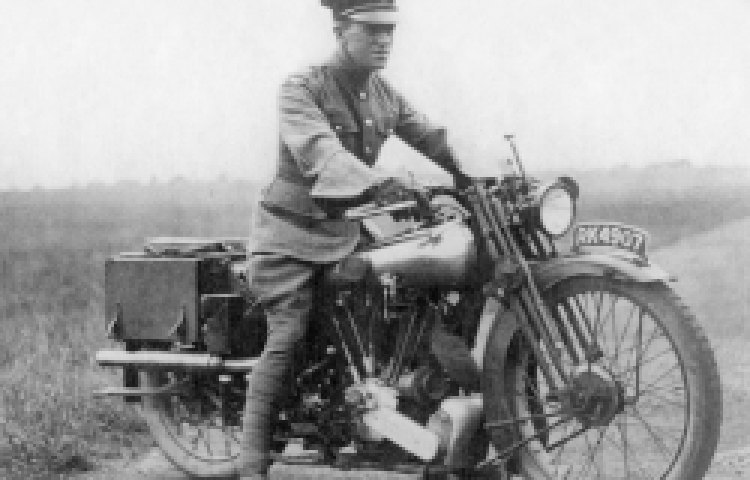
When T.E. Lawrence, famously known as Lawrence of Arabia, died from head injuries sustained in a 1935 motorcycle accident, one of his doctors wondered if wearing a helmet could have saved the war hero’s life.
Hugh Cairns, one of Britain’s first neurologists, helped treat Lawrence and eventually conducted the fallen man’s autopsy. He concluded that “severe lacerations and damage to the brain” killed the famous soldier. Lawrence hadn’t worn a helmet, something that wasn’t unusual for the time. Very few people in 1930s England wore helmets, and Cairns speculated that thousands of motorcycle deaths in Britain could be avoided if riders’ heads were protected. Though he didn’t begin topical studies until World War II, Carins’ diary revealed that Lawrence’s death sparked a curiosity which would spurn him to become the first person to conduct helmet safety research.
In 1941, Cairns published his first study which listed statistics of bikers who had died on British roads in previous years. According to BBC:
It revealed that in the 21 months before the start of WW2, 1,884 bikers had been killed on British roads. Of the cases Cairns studied, two-thirds suffered head injuries.
Things got even worse with the start of the blackouts prompted by air raids, despite petrol rationing reducing traffic. In the 21-month period from September 1939, 2,279 bikers died, or roughly 110 a month – an increase of 21%.
Though Cairns could only study a few motorcycle accident survivors who had worn helmets when they crashed, his research sufficiently convinced the British Army that wearing helmets could save lives. In 1941, the Army mandated that soldiers must wear helmets when they traveled by motorcycle. Cairns studied the policy’s effect and later revealed that motorcycle fatalities in the Army had fallen from around 200 a month to 50 a month. Soon Cairns’ ideas garnered public attention, specifically his 1943 study that showed wearing a motorcycle helmet could reduce skull fractures in crashes by 75 percent. Brits soon started wearing helmets of their own accord.
In 1973, Parliament enacted a law requiring anyone riding a motorcycle to wear a helmet. Now, thanks to Cairns’ pioneering research, and other safety improvements over the years, thousands and thousands of lives have been saved.
(h/t BBC Magazine)