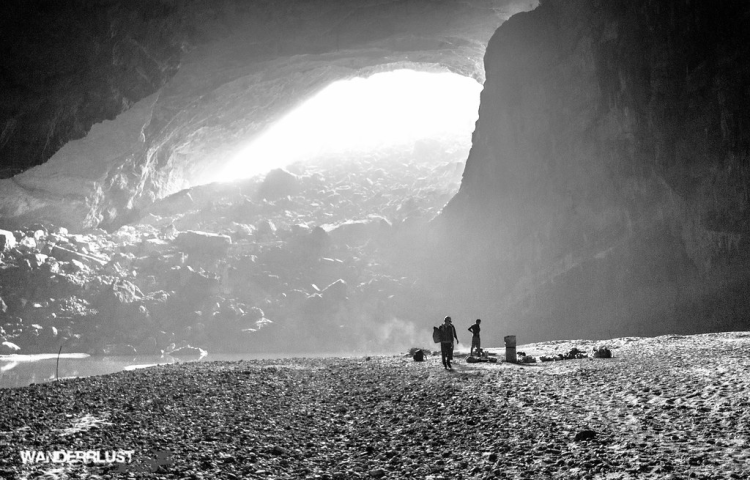
The mountains of the Phong Nha-Kẻ Bàng National Park, a UNESCO World Heirtage site which stretch across the Bố Trạch and Minh Hóa districts of Vietnam’s Quảng Bình province, are some of the most remote and spectacular in the world. A maze of caves, including the notorious Sơn Đoòng, the largest natural cavern in the world (which was only discovered in 2010), it’s an incredibly hard region to map and remains highly unexplored. Yet during the excess brutality of the Vietnam War, for some reason America and its proxies still decided to bomb the shit out of the region—and in so doing revealed one of the most isolated peoples in the world, the Ruc people.
According to the common narrative, sometime in 1959 Northern Vietnamese soldiers from Ca Xeng operating in the Thường Hóa region were surveying the aftermath of a bombing when they spotted a group of mostly naked men climbing up trees or retreating into the area’s labyrinthine caves. Estimates vary, but most accounts say they’d stumbled upon a group of 34 to 169 people who made their homes in natural alcoves in the mountains and had for an unknown amount of time chosen to remain isolated from the world. The people had no ethnic name for themselves, so the soldiers called them Ruc folk, which is basically Vietnamese for cavemen.
Linguistic work later revealed that the dark-skinned Ruc people, now officially one of Vietnam’s 53 ethnic minorities, seem to be related to the A Rem, Ma Lieng and Sach peoples of the region, all of whom speak languages from the Chut family and predate the arrival of the Viet, or Kinh, majority, which composes 85.7 percent of the nation. No one’s quite sure when or why they cut off contact with the wider world, but given their sparse numbers it’s not unreasonable to think that they probably withdrew as others of their wider ethnic lineage were wiped off the national map. That’s the common story for most of the world’s highly isolated peoples—there are a little over a hundred such tribes, mostly in the remote Amazon and Papua New Guinean rainforests.
It’s rare to find “uncontacted peoples” (as such self-isolated groups are known) outside of these regions, but there are still established procedures for how to deal with an encounter anywhere in the world. They boil down to: Leave them alone. Give them their land. The international community has over the past few decades established that trying to force contact with peoples who’ve made it known that they wish to remain isolated is both a health risk (introducing new diseases) and an affront to personal liberties. No tribe is totally unaware of the outside world, and they can and do reach out for help and integration at their own discretion. So the logic runs, it’s our duty to preserve their territories for them until they choose to join the modern world.
That’s not the approach that Vietnam went with though. Operating under the communist dogma in vogue in the country than and now, the North Vietnamese regime viewed history as progressive. Peoples move forward, developing from primitivism to a utopian modern communalism. They then classified and still describe the Ruc folk and their traditions as outdated and potentially harmful, blaming them for their low numbers and what the state saw as their dire poverty. Dubbing the Ruc people the little brothers of the Viet ethnicity, a demeaning term in line with their progressive historical development ideology, they decided to resettle them all into a village in the Thường Hóa region, giving them all houses, farms and access to modern education. (More recently, they seem to be actively marketing the Ruc tribe as an oddity, perhaps for tourists, after the tribe started to show up on online lists of the most isolated and unknown peoples in the world.)
Fortunately for the Ruc people, they did not decline as rapidly as many peoples coming into contact with the outside world for the first time in recent history have. Instead, their numbers have increased from just about a hundred in 1959 to about 600 according to a 2009 census. And the elders of the village (who consented to move because of damage to their old home, it’s said, and went to school just because it seemed like fun) have kept alive their indigenous culture of esoteric magic, music and hunting and gathering even while ostensibly living on farms. Many of the villagers opt to live in caves full-time or for part of the year as well, because they prefer it.
Unfortunately, the Vietnamese regime doesn’t seem too happy about this. State media takes a dismal view of the Ruc folk preference for living in caves, and is taking great pains to try to bring them back to their farm village and to further their goal of educating the hell out of the next generation. Literacy and learning the national language, the state believes, is the best way to mainstream the Ruc people.
And they’ve gained a great tool in that quest recently now that Ho Tien Nam has become the first Ruc man, as of 2013, to graduate from university. With a degree in pedagogy from Quảng Bình University, he’s now returning to the school where his people study, acting as a force for the state from within the ethnicity. Elders worry that the young folk of the tribe will be increasingly tempted away form their old ways of life (as is common in a period of contact). And as they move towards the modern era, their culture may vanish, giving the Vietnamese the ultimate and largely undeserved win in their tug-of-war for the future of the Ruc people.