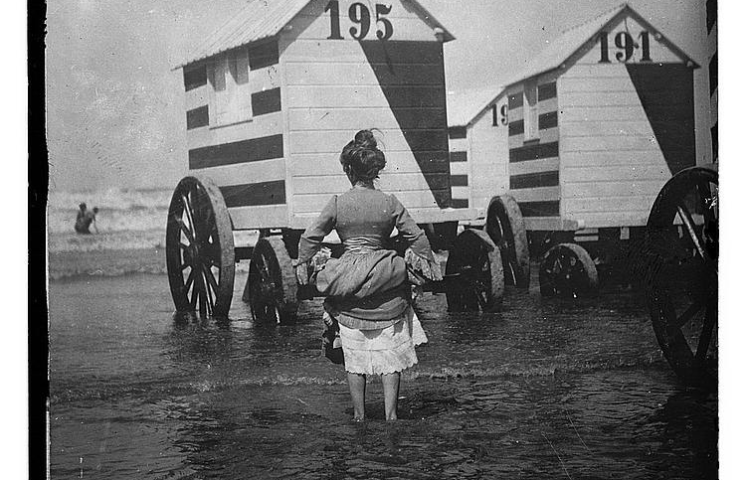
It’s a crowded day on the beach, and you just want to get your swim on. What’s a girl to do? In modern times, she’s likely to throw on a bathing suit and go for a swim. But things were a bit more…complicated during the Victorian Era. In fact, at many beaches you’d be much more likely to hop into a bathing machine than jump into the waves.
To understand the phenomenon that was the bathing machine, it helps to understand what swimming meant to polite people from the mid-1750s or so on. The thought of exposing a female body to the creepy eyes of thousands of male onlookers was anathema to people who were becoming increasingly used to gendered public spaces. Though single-sex beaches did flourish throughout the era, there were also concerns that beaches were becoming a bit too accessible to people of all classes as leisure became available to one and all.
But beaches were also perceived as healthy. In the 1760s, a doctor named Richard Russell published a book called A Dissertation on the Use of Sea Water in the Diseases of the Glands, which made swimming desirable as a healthy activity, not just a leisurely one. British people had long believed in the healing powers of waters in spa towns like Bath, and they enthusiastically transferred this love to the coastline.
In 1750, a man named Benjamin Beale invented a so-called “modesty hood” that would allow a swimmer to head into the water shielded from prying eyes. That concept slowly evolved into the bathing machine, a sort of cart on wheels or a variety of horse- or steam-powered contraptions. A swimmer would enter the machine, change clothing, be carted into the water, then jump or slide off of a chute on the other side of the small hut to swim away from immodest eyes.
Bathing machines created a whole economy on the beach. A woman waiting to enter a machine would gather in a “bathing room” to brush shoulders with fellow beach goers, then step into a bathing machine that was sometimes tricked out with a “dipper,” who pushed a person out of the machine, dragged them through the waves, decided when their swim was over, and helped them back into the machine.
Bain News Service
Though bathing machines were invented for the sake of modesty (and maybe because in the late eighteenth century, swimmers regularly did so in the nude), they weren’t the cure they were cut out to be. A museum curator told The Telegraph’s Nick Britten that “young men considered a telescope an essential aid to an enjoyable holiday,” and Fred Gray writes that the perceived control of bathing machines was the cause of much controversy throughout the Victorian period.
Still, the machines had their fans, like Queen Victoria—she owned her own private bathing machine. By 1900, the machines were so widespread they were even enshrined in case law: one case from 1898 deals with laws for licensing and advertising bathing machines on public beaches.