Cult is an ominous word. Conjuring up images of glass-eyed devotees and ecstatic rituals, for most of us it’s a pejorative term used to describe unusual spirituality. But if you ever ask what actually constitutes a cult, chances are you’ll have a hard time coming up with an answer. To some people, a cult’s only a cult if it’s a tiny group of acolytes following a megalomaniacal leader. To others, even mainstream religions like Christianity, because they influence the way people think and act and focus reverence on a set of esoteric leaders, dogmas and rituals, ought to be labeled cults.
This ambiguity stems from the fact that cult is a wishy-washy word of many real meanings. But it is possible to hybridize these definitions into a comprehensive, three-pronged one. 1. Theologically, a cult is essentially a spin-off of an existing faith or concept, using some but rejecting other mainstream doctrines to become a new faith. 2. Sociologically, cults break cultural taboos. 3. Colloquially, cults are typically small, centered around one venerated figure, and thick as thieves. Yet although cults are united in their seeming strangeness, they vary drastically in their risks and radicalness. Some cults are benign; some are malignant. Some are powerful; some are weak. Some hit a nerve and spawn their own progeny; some are just theological dead ends.
In A Cult A Day, we’ll be briefly highlighting the width and breadth of cults across the world, moving past the glitzy, demystifying the label and trying to learn some lessons along the way.
In part five of our A Cult A Day feature, we look at the Church of Euthanasia, a small organization that seems like it should be a joke, but has proven itself a dead serious radical environmental movement.
Why You Might Know It
Longtime watchers of The Jerry Springer Show may recall the Church of Euthanasia from the 1997 episode “I Want to Join A Suicide Cult.” That show’s title was a bit of a misnomer, because usually when we talk about a suicide cult, it’s a group that coerces or brainwashes people into offing themselves to reach some higher plane of existence or as an act of resistance against the mainstream world. The Church of Euthanasia merely whole-heartedly supports individuals’ decisions to commit suicide and celebrates the death of humans as means of reducing environmental pressures on the Earth. That difference may seem largely semantic, but endorsement versus incitement really does matter in a legal and functional context.
Yet many have accused the Church of Euthanasia of toeing the line between a contentious position against the value of human life and actively assisting suicidal impulses. In 2003, they were forced to take down a how-to on suicide from their website after it was implicated in the death of a 52-year-old St. Louis, Missouri-area man. Every time the Church of Euthanasia shows up in the media, it feels harder and harder to reject the notion that at least some members, even if once joking, really want us all to die, altruistically.
How It Started
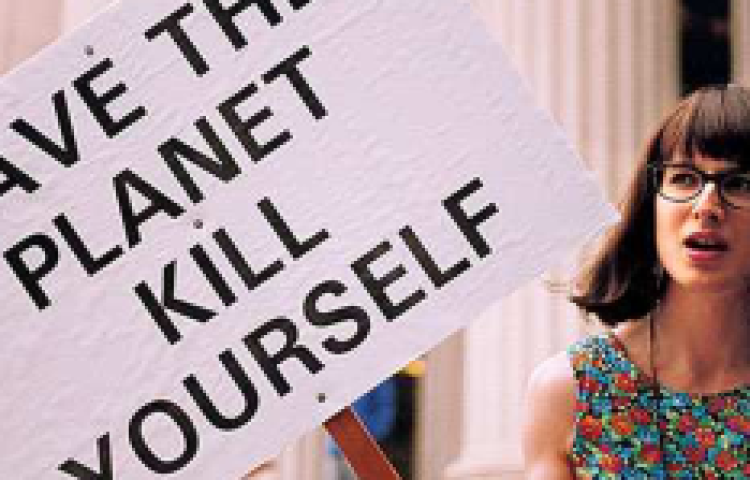
The Church of Euthanasia started around 1992, when the current Reverend, Chris Korda, claims she encountered an alien intelligence, “The Being,” who spoke to her from another dimension. The Being warned the musician-activist that the Earth’s ecosystem was failing, mainstream leaders were not doing enough to fix it, and that there was only one solution. The phrase the intelligence gave Korda became the center of the movement she spawned: in order to save the environment from unsustainable population growth, you must Save The Planet—Kill Yourself.
How It Went Wrong
Korda’s encounter with The Being raised some interesting questions that we could and should discuss more openly. Perhaps instead of putting our faith in science to eternally supply a growing population, trusting that the Earth will just muscle through, we ought to think about how to tamp down our stress on the environment via effective family planning. Perhaps that means that issues related to abortion and right to death can be discussed in environmental as well as social terms. These are not things we have to endorse, but they’re things that we might want to at least discuss. But unfortunately from the get-go Korda’s church got involved in very fiery and off-putting rhetoric that painted them more as sadists and wackos than as concerned Earth lovers.
The four pillars at the center of the Church of Euthanasia are: suicide, abortion, cannibalism and sodomy. That is about as abrasive a platform as you’ll ever find in the world. Unpacking those ideas, the Church fears that not enough people die naturally anymore, so they will tout anyone who kills themselves for whatever reason as a saint or martyr, and will accept their estates to promote their vision—but they don’t foist it on anyone. They tout abortion as a logical means of controlling the human population—but they don’t foist it on anyone. They tout cannibalism as a good way of using humans as protein rather than contaminant when we die, promoting vegetarianism in all other ways—but they don’t promote killing ever, especially to get meat. They tout sodomy as a good way of experiencing pleasure without creating more humans to help bring the population down to a manageable level—but they don’t force sexual preferences.
They believe in challenging things that are interesting to think about (even if we wind up opposing them), but they present them in the most distasteful ways possible. Case in point, three months after September 11, 2001 to the day, they released “I Like to Watch” mixing images of people dying in the attacks with hardcore porn dubbed over with music, one of the most heartless ways imaginable to get across your distaste for human life, and a great way to become pariahs and public enemies rather than to become fringe and uncomfortable philosophers we can talk to.
Why People Followed The Cult
Yet hundreds of people did and do follow the Church. They do so for the simple reason that they believe in the code of ethics it’s selling. They have honest and dread fears about the trajectory of the Earth and the unsustainability of humanity. And they believe that the only way to get people to pay attention is to be brash, outlandish and harsh. That is always an aesthetic some activists, artists or writers will adopt. We may consider it juvenile and, at the outside, potentially dangerous. But it is an undeniable impulse mixed with an undeniable concern that draws people in. For some it may be a joke. For some it may be sincere conviction. But the fact that the group ever existed and can exist as a joke or a reality ought to tell us something about humanity.
What It Tells Us about Cults
As to what the Church of Euthanasia tells us about cults, it’s a prime example in how to be off-putting. It’s a case study in saying and doing all of the wrong things if you actually want people to take your ideas seriously or have a conversation with you. It’s a recognition of the impulse in some cults to be extreme to get attention quickly, perhaps without really thinking about or truly understanding what that attention will mean for your convictions. It’s a sign of how slim the borders can be between a bad joke and reality, too. And shockingly it’s also a sign that even when you are the apotheosis of disgust, you might not (and this is especially ironic given the convictions and party line of the Church) die as quickly as some might like as an organization.