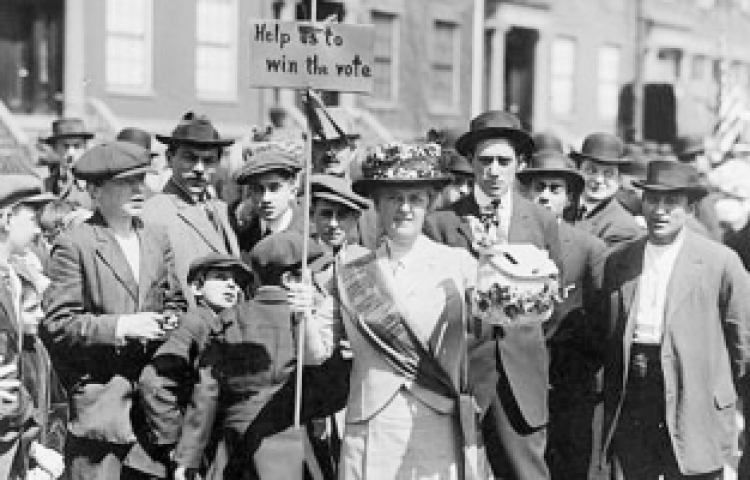
With big names like Meryl Streep and Carey Mulligan starring in the upcoming Suffragette, moviegoers are actually paying attention to the dramatic story of women’s voting rights, which in the United Kingdom and United States, are actually relatively recent. It took nearly a century of concerted effort for women to gain the right to vote in America. But after the Civil War, the movement almost seemed doomed due to an argument that threatened to split the movement apart. The issue was the rights of black men, and like the Civil War itself, it pit friend against friend and tore old alliances to shreds.
Abolitionism and agitation for the vote went hand in hand—many leaders had been fervent abolitionists, and participation in events like the World’s Anti-Slavery Convention had galvanized some early leaders in the women’s movement. But leaders did not agree on what to support as a body, and as the Civil War ended and the United States teetered on the verge of voting the Fifteenth Amendment into law, conflict broke out among differing factions of the suffrage movement.
One one side of the argument were Elizabeth Cady Stanton and Susan B. Anthony, who argued that an amendment enfranchising black men—but not all women—didn’t go far enough. They argued for an “all-or-nothing” stance: enfranchise everyone, or don’t pass the Amendment. Stanton identified the plight of women with the plight of slaves (a sentiment applied in a tone deaf manner to a Suffragette social campaign), urging all citizens to “demand that woman, too, shall be represented in the government.” Outraged at the exclusion of women from the act, Stanton and Anthony formed the National Woman Suffrage Association.
On the other side stood Lucy Stone, Julia Ward Howe and other abolitionists who felt they should support the Fifteenth Amendment and not split national support for it. “We are lost if we turn away from the middle principle and argue for one class,” argued Stone. The movement split and Stone and other pro-Fifteenth Amendment allies formed the American Woman Suffrage Association.
The split was hardly as shocking as the language used to defend it. Stanton argued that “it becomes a serious question whether we have better step aside and see Sambo walk into the kingdom first,” stating that given the huge number of uneducated and “inferior” blacks who were about to gain suffrage, white women were needed to offset their vote. Stone’s arguments for the Fifteenth Amendment were tempered with their own worries about blacks: “I believe that the safety of the government would be more promoted by the admission of women as an element of restoration and harmony than the Negro,” she wrote.
While the NWSA focused on a platform of securing “equal terms” for women and men, including the right to divorce and the right of women workers, the AWSA went on to focus on voting issues only. The split lasted for 21 years. By the late 1880s, it became clear that two organizations were splitting public opinion over suffrage and that it would be better to combine forces and focus on meaningful progress. Though the merger was contentious, the NWSA and AWSA combined in 1890, forming the National American Suffrage Association.