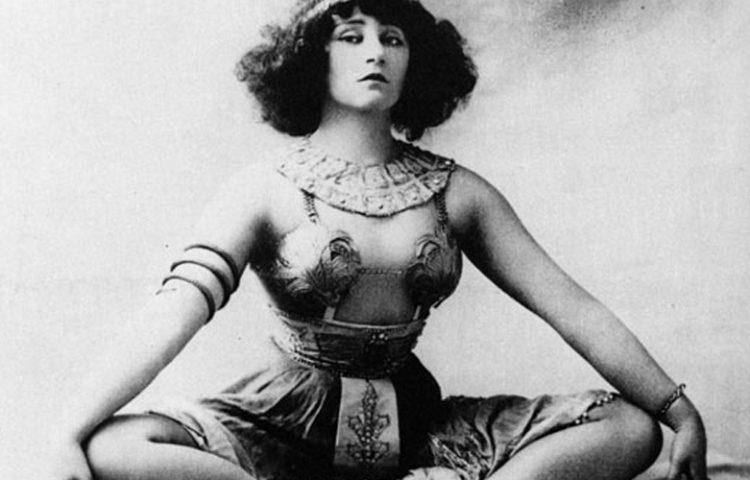
A kiss is just a kiss—unless it’s the start of a riot, too. That’s just what happened when Sidonie-Gabrielle Colette, the provocative artist known by her last name, appeared in a pantomime called Rêve d’Égypte (Egyptian Dream) at the Moulin Rouge in 1907.
Colette was known for flamboyance and controversy throughout her long life (an affair with her stepson and possible collaboration with the French Vichy regime during World War II are only a few of her accomplishments). She first gained prominence as the child bride of Willy, a famous critic who flaunted his young wife’s beauty and sex appeal.

By the time 1907 rolled around, Colette had moved on from her husband and was engaged in a passionate love affair with Mathilde de Morny, Marquise de Belbeuf, known to the rest of the world as “Missy.” The affair with Missy, whose friends called her “Uncle Max” due to her preference for wearing men’s clothing, had already incited public speculation, including racy articles that speculated that Colette and her ex-husband lived with Missy and another woman as a foursome. Reports of the “sordid commune” prompted Colette to write to one of the newspapers asking them not to “combine so…intimately in the minds of your numerous readers two couples who have arranged their lives in the most normal fashion that I can think of: according to their pleasure.”
Unconcerned about public condemnation of their lesbianism, Colette and Missy agreed to appear in a one-act pantomime at the Moulin Rouge. The Egyptian Dream portrayed a mummy being unwrapped by an Egyptologist, who eventually realizes he has discovered not a preserved corpse, but a living, scantily clad woman, whom he kisses. But the venue’s use of Missy’s family coat of arms enraged her family, who sent hired thugs and angry friends to the theater for the first performance. There they joined other onlookers titillated by reports that the play would be scandalous indeed.
In her book Secrets of the Flesh: A Life of Colette, Judith Thurman describes what happened next:
The curtain rose at ten forty-five. The stage was immediately bombarded with coins, orange peels, seat cushions, tins of candy, and cloves of garlic while the catcalls, the blowing of noisemakers, and shouts of “Down with the dykes” drowned out an orchestra of forty musicians…When the archeologist took the unwrapped mummy in “his” arms to give her a lingering and unfeigned kiss, the uproar reached a fever pitch.
A mob began to attack not just the stage, but Colette’s ex-husband and his girlfriend. Undeterred, the Moulin Rouge set a performance for the next day, but Missy was replaced by a male actor. The substitution was so unpopular that the show closed the next day—but not before Colette had exposed the double standard of Parisian audiences and made her name synonymous with scandal and provocation.