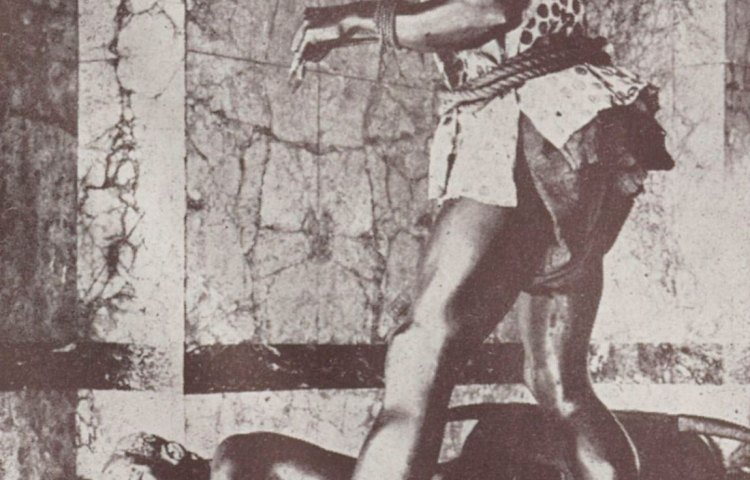
In the late 1870s, French colonial officials in Libreville, Gabon, started stumbling across the corpses of local peoples. These weren’t simple deaths, though—no victims of disease or even plain murder. They were beheaded, eviscerated, and mutilated with giant gashes like a massive leopard’s claw marks.
Panic spread as more and more corpses turned up. People blamed and persecuted slaves, commerce ground to a halt, but all anyone could agree upon was that this was the work of Leopard Men: supposedly individuals who could take the form of fierce animals to enact their bloody vengeance. The terror dragged on for the better part of three years, and then it suddenly stopped. Only to resurface once more in the 1890s, but this time 700 miles away in Nigeria, then again in the 1940s across the continent in Tanzania and as late as the 1950s in Liberia. These mysterious and ghastly leopard man murders, spanning dozens of years and an entire continent, caught the public eye in a serious way, inspiring scenes in pop culture from Tarzan to Tintin. In those works, the unsolved and brutal cases are proof of the dark and sinister barbarism of the African interior. In truth, though, these killings—so rarely examined nowadays—were a violent reactions by traditional societies across the continent, informed by each other’s methods and actions, against the social upheaval of colonialism.
While the leopard men behind the murders were impenetrable and esoteric to the colonial officials, most local peoples seem to have understood exactly who and what was behind the killings. In West Africa, especially, cults of local notables had long manifested their belief in magic, spirits, and human transformations by periodically donning leopard skins, steel claws, and false footprints. These secret societies “turned into leopard men” whenever power relations or social norms began to tip out of control, doling out justice in secret to eliminate upstarts and maintain the status quo in the guise of a spiritually sanctioned act rather than blunt murder.
The murders were supposedly rare occurrences before the late-19th century, an era of unprecedented European penetration into the geography and affairs of Africa. But when the murders picked up, they seemed to target the lowest classes, especially slaves and women. Modern studies credit this to the advent of European power in the region—messing with old social norms and allowing new relationships of power and patronage to elements of society, emboldening them to stand up to local elites, even murdering chiefs. The cults went into overtime trying to take out these disruptive elements, possibly spinning out of control into an excuse for more general murders as the killings became less rare and easier to copy and cover up.
Some believe the murders finally stopped in a given region because fear of mass violence eventually led to a détente. But it seems far more likely that the colonial officials caught onto the phenomena. While for a time they might have tolerated the attacks as great justifications for their invasion of barbaric and benighted lands, and solid tools for exploitable destabilization, when the attacks started impacting European lives or economic interests, they cracked down hard, eliminating the traditionalist forces of a region and viscerally asserting their authority and the staying power of their new order.
But once the murders stopped in one region, they’d begin in another. In many ways, the spread of the leopard man murders was a chartable map of the incursion of colonialism into Africa and resistance against it. More historically interestingly, the spread of the murders all across sub-Saharan Africa in one form or another may be a sign of the little-known interconnections between supposedly isolated traditional African cultures, borrowing and innovating on each other’s traditions—even the bloody ones. But the cessation of the murders full stop is just as significant in the mapping of African history. The close of the era of the leopard men marked the close of a phase of African history, the end of one type of resistance and the beginning of a new continental social norm and struggle.