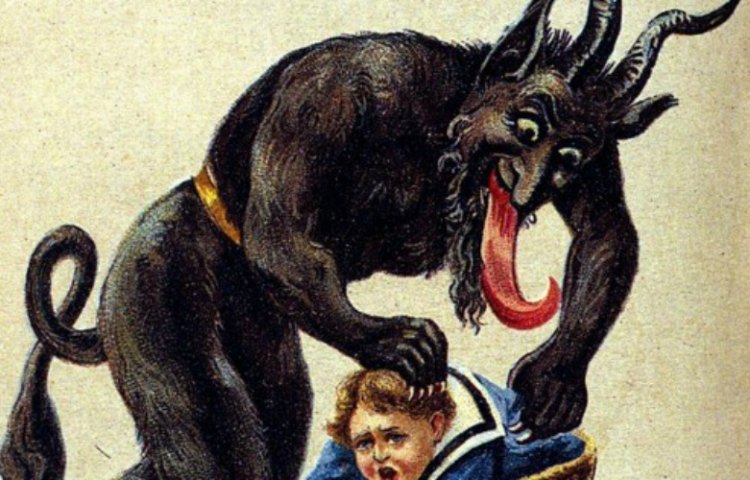
Gather round, kiddies, and try not to fear the giant horned beast who comes to greet you on Christmas. Krampus is a straight up monster and beloved Christmas tradition to several Germanic and Alpine cultures. But where did he come from? In a time of family, gift-giving and eggnog, where did a half-goat, half-demon beast who beats children come from? From Pagan traditions, of course!
Krampus is traditionally depicted as a seven-foot-tall horned beast with a grotesquely long tongue used to whip bad children (haunting and perverted). His name comes from the German word krampen, which means claws. Claws. The bad kind, not the Santa (Claus) kind.
Krampus is a dark counterpart to the jolly Santa. While Santa gives gifts to good children, Krampus whips the bad ones and takes them into his evil lair for more torture. Krampus comes to town the night before St. Nicholas on Krampusnacht to weed out the bad kids in order to make Santa’s gift giving easier. In some countries, drunk men dress up as devils on Krampusnacht and chase kids through the streets which somehow manages to be more horror-inducing than Santa Con. You can see several videos of Krampusnacht on Youtube.
Krampus’ origins stem from Pagan tradition rooted in Norse mythology practiced in northwestern Europe in the days before Christianity. Yuletide itself was a Germanic Pagan tradition celebrating the winter season. Animals were sacrificed to the darker, shorter days and there was a lot of drinking and “celebrating fertility” as they ate the year’s harvest. Early Christians were pragmatic. When trying to convert folks away from their “savage” religions, recruiters adapted some already existing Pagan traditions and put a Christian-spin on it. The Christmas tree? Pagan. Christmas being celebrated on December 25th? An adaptation of Pagan Solstice celebrations. Santa’s judgmentalfriend Krampus? Very Pagan.
Krampus is believed to be derived from the German goddess Perchta, who had cloven feet like Krampus and would slit people’s bellies open and stuff them with straw if they did not leave her offerings on the feast day. She would also enter your house mid-winter and leave gifts to hard-working children who obeyed their elders, but punish those who slacked off. Solstice and other Pagan practices permeated harvesting season. Perchta encouraged children to work hard for a bountiful harvest. Perchta’s traits were adopted into Krampus around the 17th century. It is not certain when exactly, but there are 18th century drawings and holiday cards depicting Krampus and Santa Claus.
Although Americans do not necessarily recognize Krampus, there is a similar character in Amish communities. The Pennsylvania Dutch once celebrated a character named Belsnickel, a grumpier version of Santa Claus who whips naughty children (he has since faded from most Christmas traditions). He would go around the village and ask children to recite a Bible verse. If they failed to do so, then they would be whipped.
Merry Christmas!