You would think that in the midst of a war, armies would have little time for such frivolities as a magic trick—but think again. In fact, during the World War II, the Allied forces became so invested in deceiving the enemy that they enlisted a magician to do it. This man turned out to be rather successful, in turn, at creating an illusion of his own “magical” role in the fight to win the war.
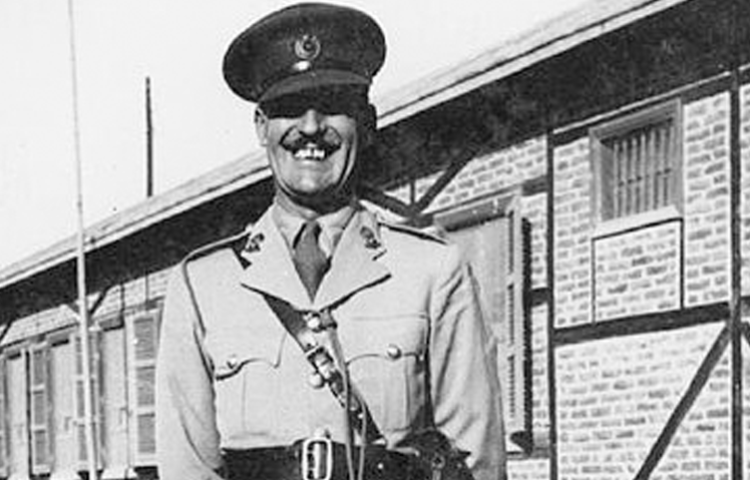
His name was Jasper Maskelyne, and he was well-versed in the art of deception. He first grew popular as a magician who entertained eager audiences with his tricks. But when war rumbled across England, it stripped the British magician of his stage and crushed the once-roaring trade, leaving Maskelyne without a job. However, it wasn’t long before the resourceful character set his sights, rather unexpectedly, on the British military.
Marketing himself as a camouflage extraordinaire whose vital talents were going unused, Maskelyne eventually secured a position at a camouflage training school run by the military. According to some sources, after he impressed a particular officer with an elaborate illusion, he received a job in Egypt. There, British troops were stationed, ready to stave off the German advance into North Africa—and somewhat sceptically, the army induced Maskelyne into their ranks.
Quickly, the magician set to work trying to impress his superiors. Among his magical wartime inventions were several auxiliary aids intended for British soldiers. For instance Maskelyne developed a miniature compass housed in a jacket button, a hair comb that could be converted into a blade when in danger, and playing cards with maps printed on the back so that soldiers could secretly know their whereabouts. But as entertaining as these trinkets might have been, it was his bigger illusions that made him famous—grand deceptions that played out on the landscape scale.
One of these centered on the Egyptian port city of Alexandria, where the British army housed many of its battleships, making it a prime target for aerial bombardments by the Germans. To test his capabilities, military officers came up with a task for Maskelyne: they instructed him to hide the bay. It would prove to be a mammoth feat for a magician used to small sleights of hand—but apparently, Maskelyne pulled it off.
With a team of devotees he called “the magic gang,” the magician set about doing the unthinkable: using visual trickery to build an entire, life-size decoy port. With the help of engineers, he constructed props including military vehicles and an entire lighthouse, and even developed a complicated lighting system that was to be spread out in the shape of a city, representing Alexandria. When everything was built, the team transported it all to a nearby coastal curve that was shaped much like the true port of Alexandria. As the German bombers approached, Maskelyne orchestrated it so that Alexandria turned off its lights, and those at the fake port were switched on. The hope was that at night, when the Germans were bound to attack under cover of darkness, they would be confused by the geography and attack the illuminated fake port instead.
Astoundingly, Maskelyne’s plan succeeded, and for three nights the Germans bombed the wrong place, leaving Alexandria safe from attack. Hundreds were saved and Maskelyne had triumphed. According to a biography about his life, the sterling magician went on to lead even grander exploits, including the “vanishing” of the Suez Canal, which was designed to confuse approaching German pilots.
There’s just one problem with this story: modern-day historians note that no one but Maskelyne himself can prove that any of it is actually true. Most of the details about his triumphant wartime years come from one source: his biography, a book called The War Magician, which he oversaw as it was being written. Indeed, the wartime stories it contained may well have been the biggest heist of all.
There’s little to no proof in the official record of any of his major feats, and in fact, many researchers have exposed holes in his stories, and have serious doubts that any of them even occurred. The more generous historians say that if large-scale deceptions—like the vanishing of Alexandria—did indeed take place, then Maskelyne’s role as a magician was marginal, and it was the military and a team of engineers that most likely got the job done. One fact is indisputable: wartime records indicate that Maskelyne was eventually transferred from his military job to a position entertaining soldiers with magic tricks instead—which reveals something about the way he was perceived by the military.
It seems that for the rest of his life, Maskelyne lived vicariously through his book, and it was through this book that he experienced his biggest success of all: he managed to perpetuate the illusion of his wartime heroism for decades to come. Still today, many believe that the tales of his trickery are true.
We do know that a handful of his claims were legitimate. His true legacy, it turns out, amounts to his soldier’s trinkets he made: the compasses, knife-combs, and mapped playing cards were all real. Perhaps they found some action in the war.