Navy Admiral. Programming genius. Force of nature. Grace Murray Hopper wasn’t just a groundbreaking figure in the history of computer science—she’s credited with helping computers go mainstream.
A curious and persistent child, Grace Murray decided on an unusual career path for a woman born in the first decade of the 20th century: mathematics. She graduated with honors in math and physics from Vassar and received her Ph.D. from Yale. As an instructor at Vassar, she became well-known for her ability to bring dry topics to life. Perhaps this skill set is what made her so suited for translating complex computing concepts to different audiences.
Like many women of her day, Grace (who was already separated from her husband, Vincent Hopper) took advantage of the opportunities offered by World War II, joining the WAVES (Women Accepted for Volunteer Emergency Services). As Lieutenant Hopper, she was assigned to Harvard’s Bureau of Ships Computation Lab. At the lab, she met the machine that would change her life: Mark I, a gargantuan early computer designed to eliminate human error from military calculations. Determined to understand the loud, huge machine, she began to study its blueprints and schematics, learning the vocabularies of different Naval stakeholders so she could run their programs. She ended up writing a manual for the computer, a 516-page work as impressive as the calculating machine itself.
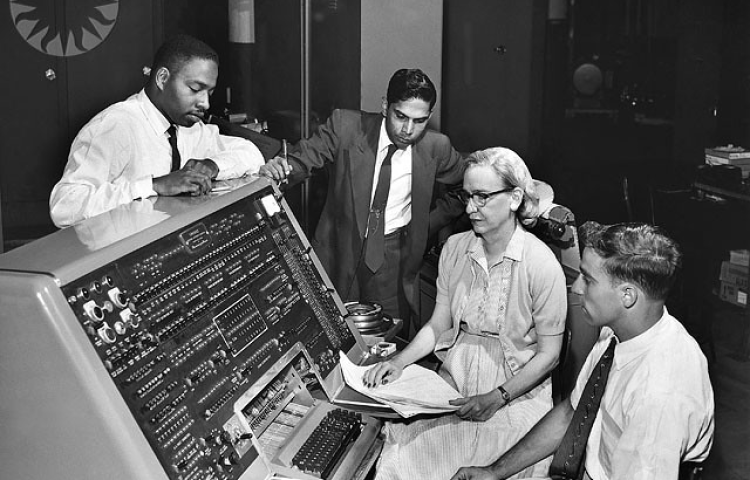
When the war ended, Hopper decided she wanted to stay in the Navy. But she had seen the future and was convinced that computers were eventually going to be for the masses, not the military. In 1949, she joined Eckert-Mauchly’s UNIVAC I effort, inventing a compiler that translated mathematical code into mechanical functions and even recommending that machines use codes in English. Though she was repeatedly told that code couldn’t be in English, she persisted, eventually helping create COBOL, a programming language that is still in use today. Hopper’s championship of COBOL and other innovations in computer coding ensured that eventually, real people would be able to control computers (not just academics or the military).
Though Hopper racked up awards and accolades in her lifetime, eventually becoming one of the U.S. Navy’s longest-serving officers, she is best known for something much more mundane: a moth. Though engineers had long used the term “bug” to refer to glitches, Hopper was amused to find a moth inside the Mark II computer she was working on in 1947. She jokingly called her team’s removal of the moth “debugging”—a term that programmers use to this day.