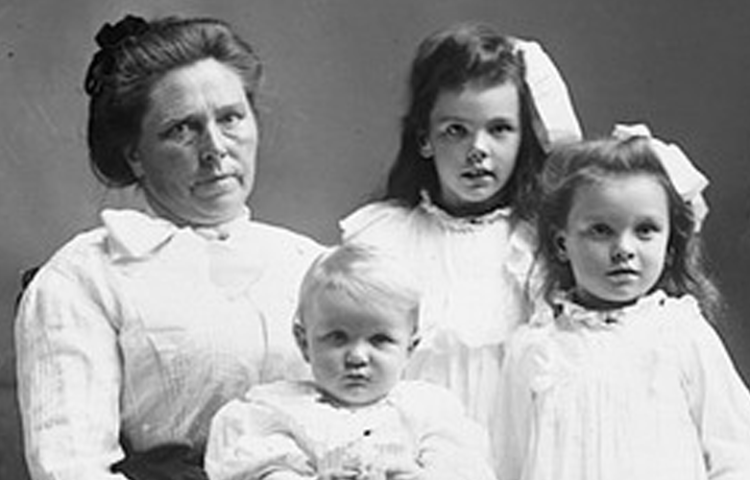
In the early hours of April 28, 1908, Joe Maxson awoke as a fire blazed through the La Porte, Indiana farmhouse he worked at as farm hand. He tried to wake the owner of the farm, Belle Gunness, and her three children, but heard no response. He escaped, ran for help, but there was no sign of the mother or children. It wasn’t until late in the following afternoon that the bodies were discovered in the cellar. And inexplicably, the body of Belle Gunness had no head.
Twenty-five years earlier, in 1883, Belle Paulson emigrated from a small town in Norway to Chicago, Illinois. She married a watchman named Mads Sorenson (what a name). The Sorensons were poor and—well, it seemed so at the the time, at least—incredibly unlucky: wherever they moved, fire followed. In 1896, the confectionery the couple bought burnt down. Then the Sorensons’ home nearly burned down. In both cases, although Belle’s stories didn’t quite add up, the insurance companies paid up.
The Sorensons’ “misfortune” did not stay within real estate. Although they had no children together for the first several years, they fostered several, including a baby named Jenny Olson. In 1896, Belle and Mads had their first child of their own, a little girl named Caroline; however, she died at only five months. Their first son died in infancy as well. While child mortality was far more common back in the day, both died of “severe inflammation of the lower intestine,” a common sign of poisoning, and both were insured.
Soon enough, Mads’ luck ran out, too. According to Ann Jones’s Women Who Kill, Mads’ doting wife gave him a “powder” to help with a cold, and he just happened to die on the “one and only day that his two life insurance policies with two different mutual benefit associations overlapped.” Belle took the whopping $8,500 in insurance money to buy a farm in La Porte, Indiana, where the real fun began. Fun, of course, being murder.
The “Gunness” in Belle Gunness comes from her second marriage to a man named Peter Gunness who died in what is arguably the worst kitchen accident to ever occur (if it did at all): after overturning a pot of hot water and scalding himself, a sausage grinder dropped from the shelf, hitting him in the forehead. Jenny Olson—yes, still alive—confirmed the bizarre death, and Belle pocketed another $2,500 in life insurance cash.
After a series of abruptly-quitting hired hands with whom Belle just didn’t get along—except for a Ray Lamphere who Belle not only had to fire because he wouldn’t leave her alone, but also prosecuted and had him charged with insanity—Belle Gunness decided to take out a classified ad in a Scandinavian newspaper that circulated the Midwest:
Wanted — A woman who owns a beautifully located and valuable farm in first class condition wants a good and reliable man as a partner in the same. Some little cash is required for which will be furnished first class security.
Although enticing, the ad was essentially a death trap. Gunness required eager men to bring cash—often their life savings—with them, and to keep their correspondence secret. Many of the men who set off with dreams of owning a farm, and maybe even making a wife of Belle, left without telling their friends or family where they were going. It is unknown how many men answered the ad, but one of them was certainly Andrew Helgelein. When Andrew never returned home, his brother Asle, after discovering that Andrew had corresponded with Gunness and that there had been a huge fire in her farmhouse, set out for La Porte, Indiana.
Helgelein arrived in La Porte and, with the sheriff’s permission, began digging on Gunness’ property. On May 5, Helgelein’s suspicion was verified: his brother’s body was discovered buried beneath the hog pen. The digging continued and twelve more more bodies and several body parts were unearthed. Another haunting discovery was the body of Jenny Olson, who Gunness had told neighbors had left for school out west. It is believed Gunness murdered more than 40 people between 1884 and 1908.
But the biggest mystery remains of Belle herself. Was she the headless corpse discovered in the cellar? Or was she the mastermind who got away with mass murder and lots of cash? The day before the fire, Gunness met with her lawyer to draw up a will. According to the La Porte Library, Gunness is quite conveniently quoted saying: “I’m afraid [Ray Lamphere]’s going to kill me and burn the house.” Lamphere did wind up falling on the sword for the fire. He was charged with arson and four counts of murder. Prior to his death in 1909, Lamphere confessed that he’d helped Belle escape and then returned to La Porte to set the house on fire. He claimed the headless body was a housekeeper Belle had hired. Oh, what a man will do for love…
There many more theories on Belle Gunness including one that supports Lamphere’s claim—she was about to be found out so she cut her losses and fled the scene with Lamphere’s aid. Some believe it was Lamphere who murdered Belle and her family in a jealous rage. But that doesn’t really account for the headless corpse (the head was never found) or that authorities found that it, as well as the children’s bodies, had high levels of highly toxic strychnine. In 2008, researchers at the University of Indianapolis attempted to close the cold case once and for all with forensic analysis. DNA testing was done on the headless skeleton, but the results were inconclusive.
Following the fire, there many “sightings” of Belle Gunness. Most were discounted, except one in 1931: Esther Carlson, a 71-year-old woman, was arrested in Los Angeles for murdering the man for whom she was caring. Weapon of choice? You guessed it: poison.
Carlson died in jail before trial, but according to a press report, investigators discovered a picture of Belle Gunness and her children lying in the bottom of her trunk.