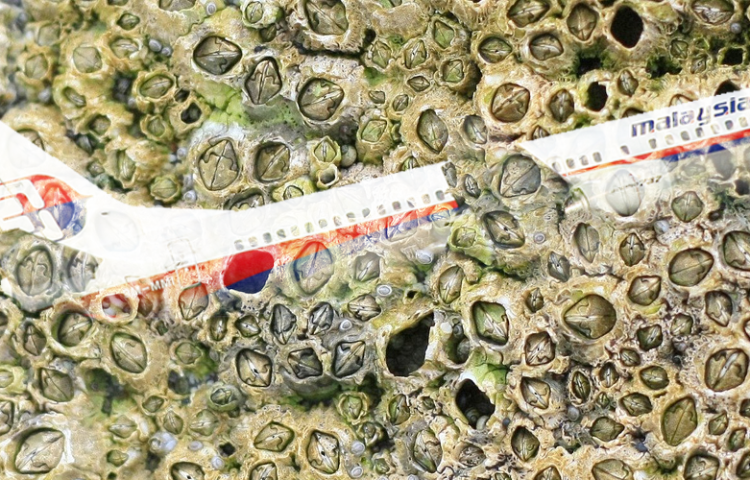
Chances are the last time you thought about a barnacle was when you painfully crunched your foot onto one of these crusty critters at the beach. But the otherwise nondescript little arthropods are suddenly making headlines. Researchers say barnacles could help them figure out where Malaysia Airlines Flight MH370 went down in the sea, and in doing so, they could help solve one of the biggest maritime mysteries in our history.
On March 8, 2014, the Malaysian airplane departed from Kuala Lumpur airport in Malaysia, and soon afterwards disappeared over the Andaman Sea, carrying over 200 passengers on board. After its final signal bleeped out, crews on the ground completely lost track of the plane, and over a year later, experts are still searching for clues, trying to understand what could have gone wrong.
That search recently unearthed a prize piece of evidence: on July 29, a portion of an airplane’s wing washed up on the Indian Ocean island of Réunion. Soon after, authorities confirmed that the mystery wing bit had belonged to Flight MH370, and the media went wild. What’s the value of a broken wing part, thousands of miles from the Andaman Sea, you may wonder? That’s where the barnacles come in.
When photographs of the washed up plane debris started circulating on the internet, a few researchers noticed that there were gooseneck barnacles attached to the edges. These unusual, triangular arthropods cling to all manner of marine wreckage, and even hitch rides on animals like turtles and whales. In fact, researchers studying marine animals use barnacles to tell them more about the routes that animals follow on their migrations. The source of this innate knowledge is in a barnacle’s calcareous shell.
As barnacles grow, their calcium carbonate-rich covers take on the features of the surrounding sea: they absorb ingredients that can reveal clues about the temperature, salinity and chemical composition of the waters they developed in. By dating their shells, we can also find out how old barnacles are. This wealth of detective data then enables researchers to match the information contained in the shells to ocean regions where the same measures of salinity, temperature, and chemical composition occur.
That effectively turns the Malaysian plane-loving barnacles in route mappers: in revealing their own origins, they can also reveal where they first attached to the debris, and therefore, where the plane wing might have come from.
Estimating where Flight MH370 disappeared along its route is a mammoth task, but with the barnacles’ help, it could become a little easier. By examining the arthropods shells, researchers think they could potentially narrow the search to within hundreds—perhaps tens—of kilometres of where the missing plane might be.
Just hold that impressive fact in your head next time a barnacle inconveniently lodges itself in your foot.