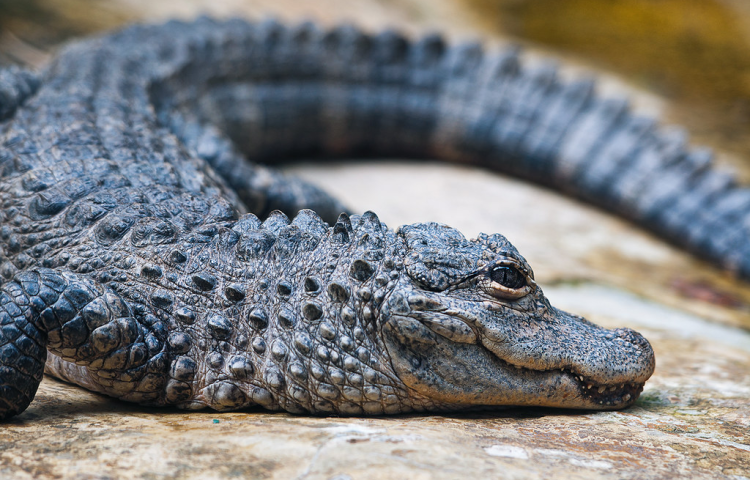
Alligators use their deep bellows to broadcast their size, like shouting their measurements into a megaphone, according to a study published this month in The Journal of Experimental Biology. The research adds to what science already knew: birds and mammals—including you—use sounds to let everyone around them know how big they are.
“An alligator bellow is one of the most impressive—and at night in a swamp, terrifying—sounds I’ve ever heard in my thirty plus years doing bioacoustics,” Tecumseh Fitch told Modern Notion. Fitch is an evolutionary biologist and cognitive scientist at the University of Vienna and one of the authors of the study. He also emphasized that the team of scientists who worked with the alligators used heliox to help analyze the alligators’ vocal calls, not helium, as was reported by Popular Science. Heliox is a mixture of helium and oxygen. It changes the resonance of sounds to make them more detectable. The frequency in the sounds stays the same with heliox but the resonance is stronger. The gas doesn’t alter breathing at all. The mixture flows more smoothly through the lungs than regular atmospheric air. And it’s safe. Underwater divers use heliox to help them breathe easier beneath the waves, and doctors use heliox as a medical treatment for patients with difficulty breathing.
The researchers gave the heliox to Chinese alligators from St. Augustine Alligator Farm Zoological Park in St. Augustine, Fla. They contained the scaly critters in sealed tubs—like the kind you might see melons in at the grocery store—and measured the frequencies of the animals’ bellows made with both regular air and heliox in the chamber. By comparing the measurements, they could determine when the sounds had the most sound energy, shown at the highest peaks of the sound waves on their charts.
Other research has demonstrated that when you and I talk, those peaks, called formants, are related to our size. And birds make use of the same vocal trick. So Fitch and the team concluded that alligators also shout out their measurements, perhaps to attract a mate or warn off competition. Alligators “enrich our understanding of what aspects of bird and mammal behavior evolved convergently,” Fitch said.
Since alligators and birds share a common ancestor with dinosaurs, alligator bellows could help us learn more about the sounds a Triceratops or a T-Rex may have made. And Fitch and the team of heliox-delivering scientists suggest the grunts could even shed light on our ancient reptilian ancestor.