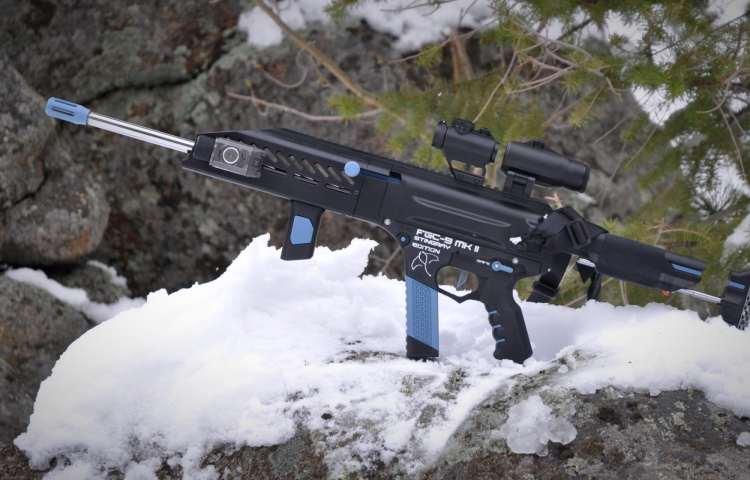
This May, police raided the house of a 27-year-old Japanese man named and promptly arrested him when they found several illicit firearms with no ammunition. If that were the whole story, it would never have cracked the international headlines the way it did. The weird thing about the arrest was that the weapons were fully functional, but made of plastic, homemade using cheap, personal 3D printer and held together with a few pins, screws, and rubber bands. The police targeted this particular house because they knew from online video of him firing his creations alongside captions like “a gun makes power equal!!” that he was a member of a growing digital collective of gun rights advocates and open-source home manufacturing experimenters obsessed with making everything from pistols to semi-automatic rifles to grenades and explosives from their home desktops.
This loose community, centered on file sharing site Free Open Source Software & Computer Aided Design, seemed like sci-fi just two years ago. But at the close of 2013 the movement’s founder and 3D printed guns pioneer of Defense Distributed, 25-year-old American Cody Wilson, had been listed as one of Wired Magazine’s 15 most dangerous people in the world. Just how Wilson and his ilk got from fantastical futurism to one of the 2014’s most challenging legal and security puzzles is a terrifying testament to the innovative power of home developers and personal manufacturing technology.
In 2012, when Defense Distributed announced that they were working on a plastic gun design for home download, many security experts laughed. Many still do. Such devices, they claimed, would never work as early plastic gun experiments resulted in explosions and misfires. Even then, the guns deteriorated after one shot, often with limited accuracy. Ballistics experts in Australia, Israel, and the United Kingdom all claim that the 2014 iterations of the guns have the same shortcomings. Even if the guns only squeeze off one shot, they’re still deadly. Cheap and dispensable, the 3D printed guns become even more dangerous for their supposed flaws. In fact, 3D firearm proponents claim that new models are much more durable, efficient, and still remain very affordable.
The gun most ballistics experts have tested is the Liberator, the first successfully tested and mass distributed 3D printed gun design released by Wilson in May 2013 and produced with less than $100 worth of plastic on a $8,000 industrial-sized printer. Although it could fire only one shot before degrading, the Liberator was still a cheap and simple design upon which to build, and it opened the floodgates by proving that such weapons were possible. Worried law enforcement officials demanded that Wilson remove the design files from his site while they figured out how to legislate this new 3D printed guns world, but only after 100,000 copies had been downloaded and mirrored onto unregulated file sharing sites like The Pirate Bay.
From the Liberator’s basic design, innovations took off with a shot. Within the month, a Wisconsin tinkerer used a $1,725 Lulzbot printer with $25 worth of plastic to retool the Liberator to fire eight shots with no damage (although each shot required removing and reloading through the barrel). By July, a Canadian gunsmith had introduced the Grizzly, a .22-caliber rifle with a 4-shot capacity, then another home armorer developed the five-shot, .22-caliber Reprringer derringer revolver, which through the use of a few screws and a piece of 8 millimeter metal tubing inserted into the barrels allowed for a more compact design. The Japanese invetor’s design was yet another improvement on the form, a modified .38-caliber German Mauser Zig-Zag he called the ZigZag, which could fire six shots at least. Although far from the efficiency and lifespan of the average Saturday Night Special, the progress is dizzying, considering these designs are only a year removed from impossibility. And gunsmiths believe they’re rapidly approaching parity with standard manufactured weapons—especially as Solid Concepts has begun printing using metal rather than plastic.
Most of this innovation has gone unchecked in the US at least because, technically, there’s nothing illegal about making a gun in your own home. So long as the firearm is not undetectable (i.e. it contains at least enough metal to set off a detector, which most designs do by incorporating screws and ammo, or a slot for a metal plate with no other function), home gun manufacturing is permissible and any challenges to home 3D gun printing in-and-of itself may, legal experts believe, pose constitutional challenges. Regardless, the city of Philadelphia has passed a ban on 3D gun printing wholesale (although they’ve never found one in the city) and the state of California passed a bill requiring a permit to build and the affixation of a Department of Justice-issued serial number to any manufactured guns.
As there’s not much legal ground to stand upon in banning home gun printing, these initial regulations will most likely fail if and when they are challenged in court. Technically, manufacturers will already be in violation of law if they create guns they are not licensed to own, so there is no need for further legal restrictions. But practically, the increased ease of access and anonymity this technology offers does require a reassessment of legal constructs around gun ownership and home design. And legal minds ought to set to it considering that the 3D gunsmith community has already started developing designs for individual elements of semi- and fully automatic pistols and rifles, like the AK-47, AR-15, and M16, which though already illegal will prove far more troublesome if it becomes easy to assemble them piecemeal at home.
Short of placing severe restrictions on 3D printing itself, though, there seems to be very little that one can do to regulate the rapidly growing industry. Or that is Homeland Security’s rather pessimistic take, at least: the genie is out of the bottle, and we’re not sure how to put the cork back in. For now, many security experts take solace in the fact that 3D gun printing is more expensive than simply buying a $400 handgun on the black market, and requires some degree of time and mechanical expertise.
But this is only true for the first few printings. With some 3D printers now as cheap as $800, guns like the Reprringer requiring less than $5 of plastic, and print times shortening every day, the monetary and manpower costs of the weapons are falling through the floor. As it becomes easier for hobbyists to produce these guns, if any of them get it in their mind to become dealers, they could make cheap, one-use guns even cheaper and more widely available, especially in regions with previously high gun control laws (it’s noteworthy that some of the highest download rates are in anti-gun Brazil, Germany, Spain, and the United Kingdom).
It’s a brave new world of utterly uncertain regulation, but it’s a world in which these weapons may become a serious security concern within a matter of years. So no matter how tricky, someone has to attack the maze of legislation, monitoring, and regulation head-on.