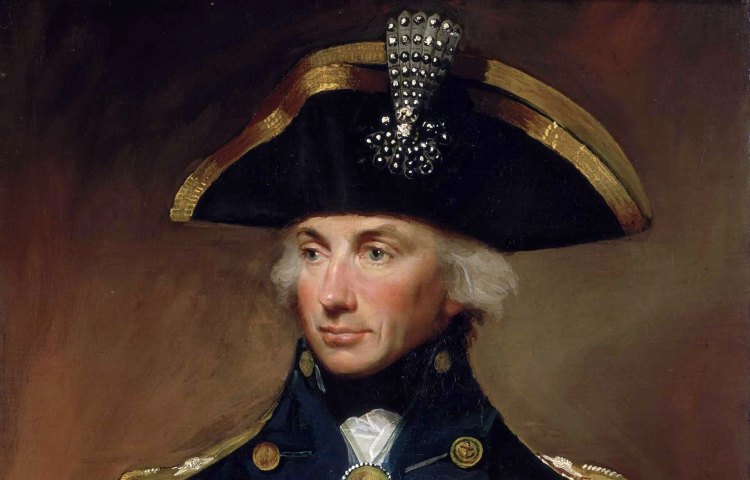
Today, “to turn a blind eye” means to deliberatly ignore a rule or someone breaking a rule. In a way, the meaning behind the modern phrase hasn’t changed much since its origins in the early 1800s, but whoever the term applies to probably wasn’t in the middle of a naval battle with literally one eye. And that’s why the origin of “to turn a blind eye” is pretty badass.
The story goes that during the Battle of Copenhagen, which pitted a fleet of British ships against a joint fleet of Danish and Norwegian ships, a one-eyed man by the name of Vice Admiral Nelson was leading the British charge in a ship called the HMS Elephant. As the battle raged on and the British lost more and more ships, Nelson’s superior, Admiral Sir Hyde Parker, decided the best course of action was to pull out of the conflict.
According to HistoryExtra, to do so, he had to signal Nelson’s ship by waving a series of flags. However, Nelson, who believed they could win the battle if they kept pushing forward, had other plans; he raised the telescope to his blind eye and proclaimed: “I have only one eye, and I have a right to be blind sometimes… I really do not see the signal!”
Yes, he literally turned his blind eye to the telescope, refused the signal to retreat and continued fighting, an action that ended up paying off because he led the British fleet to decisive victory that turned the tides of the conflict.
With that said, some historians believe that Nelson’s war story is actually a myth, but, because of the persistence of the story, many believe it truly happened in some form or another. Either way, Nelson’s actions during the Battle of Copenhagen will always have a place in history with or without the phrase actually belonging to him.
(h/t History, HistoryExtra)