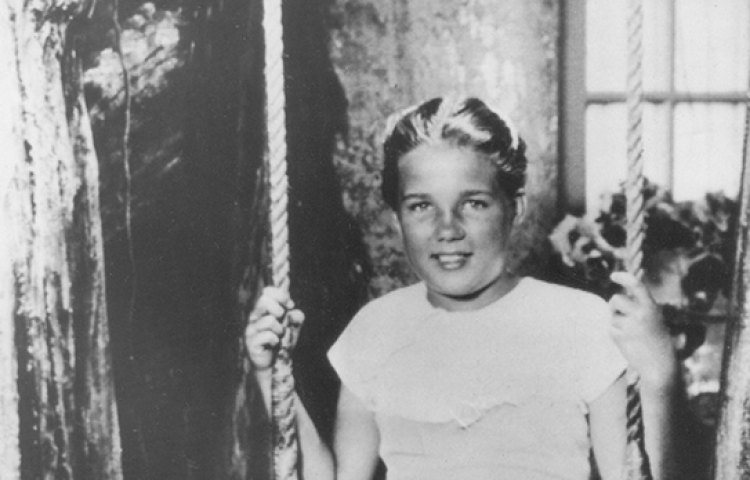
It took an eleven year old girl shoplifting a five cent notebook for Lolita, one of the greatest novels of the twentieth century, to be written.
The germs of Lolita were first written in a short story in Russian.Vladimir Nabakov put the story away for a while and moved to America where he felt compelled to rewrite the story in English and in a longer format. Thus he gave us a fascinating tale of obsession told through an unreliable narrator, Humbert Humbert, who becomes infatuated with a twelve-year-old girl named Dolores Haze.
The inspiration for Nabokov’s Lolita comes from a true story of abduction and obsession. Sally Horner was a young girl in Camden trying to join a girl’s club. As part of her initiation rites she had to steal something from the Woolworth’s where she usually bought her candy. On June 18, 1948, she rushed into the store, grabbed a notebook and stashed it in her bag. As she was on her way out, a man grabbed her arm. He told her that he was in the FBI and had witnessed her crime.
Sally cried.
The man, Frank LaSalle, lied to the little girl. He was most definitely not in the FBI. He was a mechanic who had recently finished doing time in prison for statutory rape. Of course, Sally had no way of knowing this. She was just a child trying to fit in with other girls her age.
LaSalle told her that it was good he got her and not someone else, and he asked her to comply with his demands. The next day he showed up again and told her that he had to take her to Atlantic City by the government’s orders. Sally had to convince her mother that Frank LaSalle was a schoolmate’s dad taking them on a summer beach trip. He threatened her if she didn’t do this.
At first, Sally called her mother constantly from a pay phone in Atlantic City to tell her she was having a great time. Week after week, she would drum up a new vague excuse as to why they were staying longer. She insisted she was having fun and continued writing her mother letters. After a few more weeks, the letters and phone calls stopped.
This is when Sally’s mother, Ella Horner, realized something was wrong and her daughter was likely tricked and kidnapped. She called the police on August 1, 1948.
Police immediately began investigating in Atlantic City where they discovered the man going by the alias Frank Warner had been posing as Sally’s father. They were prepared to arrest him, but found that Frank and Sally had already fled town.
The similarities between this story and Nabakov’s novel are striking. Despite the true story practically serving as an outline for the second half of the book, including a long road trip to varying cities, the girls are both young brunettes almost the same age who are daughters of widowed mothers. These stories take place only a year apart with the novel set in 1947 and the real case having happened in 1948.
Even more striking is that Frank La Salle was only involved with underaged girls, even having married a seventeen-year-old he coaxed into running away with him. He was in jail for statutory rape and was accused of assault as soon as he was released.
So, after leaving Atlantic City together, La Salle and Sally went to Baltimore for a while until they moved to a trailer park in Dallas. Neighbors thought Sally was a normal twelve-year-old girl who was rarely out of her father’s sight.
One neighbor took notice, finding Frank to be suspiciously possessive. Ruth Janish encouraged Sally to open up, but the girl remained tight-lipped out of fear. Ruth, however, hatched a plan. The Janishes soon moved to San Jose and Ruth wrote to Frank encouraging him and his daughter to move out with them where work was plentiful and they could be neighbors again. Frank agreed and decided to leave Sally alone in their new home while he took the bus into town to look for jobs. As soon as he left, Sally went to Ruth’s where she finally told the entire truth and revealed that she just wanted to go home.
Ruth let Sally use the telephone where she called her older sister Susan and pleaded for help. Susan’s husband called the FBI who immediately took action and rescued Sally, who insisted they had to hurry before Frank got home. It was March of 1950, nearly two years since her initial abduction.
The trial thankfully condemned Frank where he was sentenced to go back to prison. He initially plead guilty, but he repeatedly insisted that Sally was his daughter and this was not an abduction.
Sadly, Sally only lived to be 15. She was killed in a car accident on August 18, 1952. Frank sent flowers to the family at her funeral—the only communication he made with them after the trial—and the family refused them.
It took more than fifty years for Nabakov scholars to make all the connections between the fictional story and this real life case despite Nabakov having had newspaper clippings of the case in his notes and references to the case in his own novel. After seeing Mrs. Chatfield in a lobby and remarking that she looked ready to “pounce” on him with her fake politeness Humbert thinks to himself, “Had I done to Dolly, perhaps, what Frank Lasalle [sic], a fifty-year-old mechanic, had done to eleven-year-old Sally Horner in 1948?”
Not only had Humbert done to Dolores what Frank had done to Sally, but so did Nabakov. In this moment, Nabakov is imploring readers to look at Humbert’s actions for what they really are and consider that this is a crime that sickeningly happens in real life.
(h/t Hazlitt)