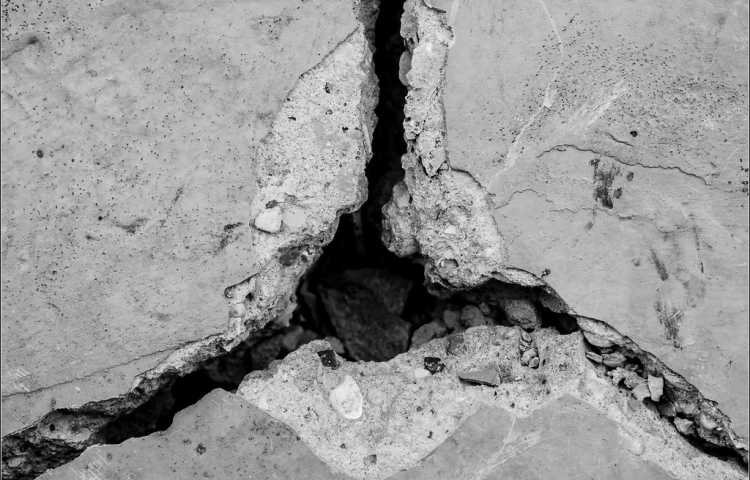
Last month, news emerged that researchers at Delft University of Technology in the Netherlands are about to start selling a new form of self-healing concrete on the mass market. Known as bioconcrete, it’s basically your standard cement, but mixed with tiny ceramic pods, just a couple of millimeters long, filled with dormant bacillus pseudofirmus or sporosarcina pasteurii bacteria (which can survive in deep sleep for up to 200 years). As soon as cracks start to form in the concrete, and water seeps down below the surface, this moisture activates the bacteria in the pod, which start to consume a bed of calcium lactate and excrete calcite (basically limestone), filling in the cracks automatically and preventing them form growing any further for years at least.
Chances are that to the casual reader this sounds kind of cool, but largely irrelevant given that it’s just a way of filling annoying little cracks here and there. But in truth, self-healing concrete may be one of the more significant commercial innovations of recent memory, as this new technology may one day revolutionize the built world we enjoy and the cost of modern life.
As far back the Roman era, concrete (whenever it was available) has been the go-to building material for almost every major construction project. Cheap, plentiful, and strong (especially when reinforced with steel), it’s especially ideal for our rapid modern urbanization and development. The world currently chokes down billions of tons of concrete a year, and global demand has grown by at least a hundred percent over the last decade as urban centers boom.
But for all its potential, concrete cracks quite easily, either due to expansion and compression in heat and cold, or thanks to the pressures of traffic and bearing heavy loads. As soon as water gets into these cracks, chemicals contained within it can help to erode concrete from within, accelerating the decay of a structure. At best, most modern concrete structures are built to survive just 50 years, but many start to break down after just two or three decades, putting many lives at risk and requiring trillions of dollars in repairs (that often don’t happen) in the U.S. alone.
Patching cracks, often quite small, is a time intensive and expensive process. But if we are able to find a way to make cracks heal themselves, as this new biocrete offers to do, even if calcite isn’t as strong as concrete, it could extend the life cycle of infrastructure by decades, easing the costs of repairs and replacements and totally rewriting the rules of urbanization and maintenance.
Given the potential of such a product (for humanity and for the profit of whoever can crack it), it should come as no surprise that many organizations have been researching self-healing concrete over the last few years. Many have, like the Dutch researchers (whose project began back in 2006, first started to take shape in 2010, and was tested in a structure in 2011), tried to utilize bacteria as dormant factories for replacement materials. (Very similar products were under development in 2012 at the U.K.’s Northumbria University and in 2013 at the Universities of Bath, Cambridge, and Cardiff.)
But development often takes quite a long time, in part because researchers have to find bacteria that could produce a calcite (or similar materials), lie dormant for years, and survive in concrete’s brutal pH conditions. Even when researchers identify viable bacteria, developing capsules that could survive concrete mixing then break apart easily and activate with a crack was an added difficulty.
As a result, other researchers (from America to Europe to South Korea) have experimented with various polymer capsules and microfibers that, when exposed to water or sunlight, expand (in various ways) to cover or fill cracks. One version of this technology developed by a researcher at the University of Michigan throughout the 1990s actually went to market in the late 2000s. This microfiber-based solution had the advantage of retaining concrete’s load-bearing capacity, which calcite fillers do not. But it also cost up to three times standard concrete, which (despite attempts to convince buyers that maintenance savings would merit the price) has kept the technology’s spread limited to date.
Unfortunately the same problem is true of this new bioconcrete out of the Netherlands. While it does not appear to be as expensive as some (admittedly stronger) polymer-based self-healing concretes, it’s still not cheap enough to merit its use unless a developer is expressly concerned with rapid decay (which most seem to ignore).
Yet researchers have hope that scaling up production and finding new, cheaper food for the bacteria involved (a key expense) will bring the price down towards parity with existing concrete mixes. If bioconcrete does manage to reach financial parity with mainstream materials, then it’ll be much easier to convince builders to use it. And if they start using it, the benefits should become clear within a few years, saving us all untold dollars and risk (more and more so as the technology continues to improve). It’s a cherry thought in the usually grim and forgotten world of infrastructure, but it’ll only come true if we can bring down the cost of bacteria chow. So let’s get a move on with that, for the good of the world’s rapidly increasing urban population at large.