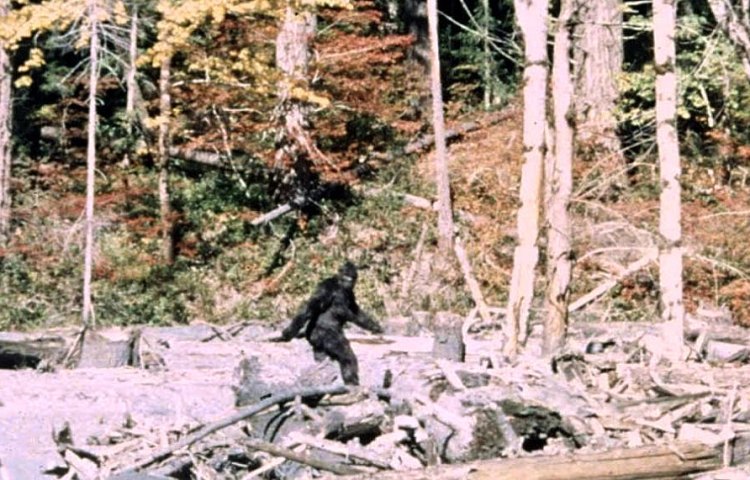
Laugh it off if you must, but the existence of Bigfoot remains one of the most storied ideas in history. After centuries of folklore, campfire tales, and blurry photos, it seems we are no closer today to the truth behind Bigfoot.
The question of this majestic beast’s existence has plagued many, but with thousands of thankless hours of service, some scientists hope we’ll soon have an answer.
These five brave scientists are blazing trails where colleagues will never go. They’re asking questions many refuse to ask—damned be the consequences. So we thought we’d give them their moment of glory with this list: five legitimate scientists who believe in Bigfoot.
Jeffrey Meldrum, Idaho State University
Dr. Meldrum has put his career and credibility on the line to pursue his research of the infamous Almasty. A doctor of biological anthropology, Dr. Meldrum has studied everything from vertebrate evolutionary morphology to paleontology. His Bigfoot projects have made him the figurehead for the scientific bigfoot community. He’s graced the pages of Scientific American and National Geographic. Meldrum maintains a growing stash of over 150 bigfoot casts, including one 400-pound plaster cast of the beast prone. “[The cast] is 40 to 50 percent bigger than a normal human,” Meldrum has said. “The anatomy doesn’t jive with any known animal.”
While he’s been outcast slightly from the science community, his defenders are a vocal bunch. Famous skeptic Brian Dunning asks for a bit of leniency. “The work of responsible scientists like Dr. Meldrum is exactly what true skeptics should be asking the Bigfoot community for,” says Dunning, “not criticizing him for it.”
Darren Naish, PhD, Scientific American Podcaster
Naish has been helping to set the stage for the rebirth of Bigfoot study. On his blog and podcast, Naish has been pushing the scientific community to embrace cryptozoology, the search for animals like Bigfoot who have not yet been proven to exist. Naish, certainly no amateur, obtained his PhD in the field of vertebrate palaeontology. He’s been investigating claims of Bigfoot and other “cryptids” for years now, and recently has begun defending the science of those investigations. On cryptozoology, Naish has a simple message for the world: “I still maintain that cryptozoology cannot and should not be considered a pseudoscience.”
Jane Goodall, Primate Expert
Jane Goodall is easily considered the most influential and well-known expert on chimpanzees. Her 45-year study on the Gombe Stream chimps reinvented the way we study animals in natural settings. On Bigfoot, Goodall says the jury’s still out. “I’m not going to flat-out deny its existence,” said Goodall to Huffington Post. This is a marked step back from some of her earlier, bolder claims. In an NPR interview, Goodall said simply, “I’m sure that they exist.” Either way, when Jane speaks about primates, the world listens.
Melba Ketchum, Veterinarian & Researcher
The Ketchum DNA project is entering its 6th year. The project is the first major concerted effort to analyze DNA evidence in support of the big fella. Melba Ketchum’s report, released in DeNovo: Journal of Science in 2013, rocked the cryptozoological world to its very core, claiming to have incontrovertible evidence that some “novel hominin” species had been uncovered to support the concept of Bigfoot. More shocking still, it seemed that not only does he exist, but he’s been taking our women. The author suggests the new genes were likely “the result of males of an unknown hominin species crossing with female Homo sapiens.” The paper was widely criticized for fraudulent citations, junk science, and huge leaps in logic. While some call it more harm than good, it certainly put Bigfoot back on the map.
Bryan Sykes, Oxford University
You can thank Dr. Sykes for the first peer-reviewed study on the existence of Bigfoot. Dr. Sykes and his team of researchers sent a call out to the world. “Send us your bigfoot samples, your Yetis DNA, and your Sasquatch hairs.” After receiving samples from over 30 countries, the Oxford team rigorously tested each with fingers crossed. “I thought there was about a 5% chance of finding a sample from a Neanderthal or (a Yeti),” said Sykes. While none of the samples turned out to be Bigfoot, hope remains. “The fact that none of these samples turned out to be (a Yeti) doesn’t mean the next one won’t.”