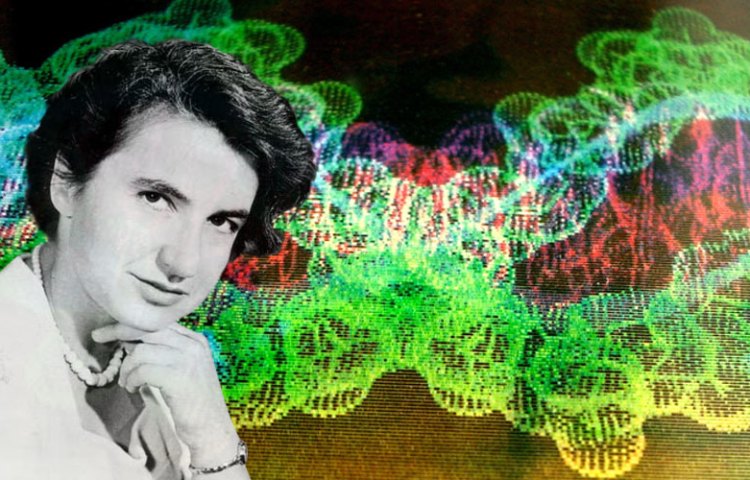
Perhaps you’ve heard the story. James Watson and Francis Crick, two male scientists, cracked the DNA code with now famous double helix structure in 1953 with the help of Maurice Wilkins. But credit wasn’t given where it was due. They stole from scientist Rosalind Franklin whose contributions have been buried in the sexism that prevailed in mid-century labs. But how much of this story is accurate?
Rosalind Franklin was a remarkable scientist. She had a PhD from Cambridge at a time when most women could not even dream of going to college. In 1950, she was invited to work with a team of scientists at King’s College to study living cells. She worked with Maurice Wilkins and the two butt heads constantly. She assumed she would be working on DNA on her own. He assumed not only that they were working on the project together, but that she was his assistant rather than his peer. These misunderstandings, along with their different personalities clashing, led to a tense working environment.
The story then goes that Wilkins took Franklin’s data on X-ray diffraction and shared it without her knowledge with Watson and Crick. It was the breakthrough they needed to understand the mysterious and evasive structure of DNA. Soon after, they published their findings on the double helix, and the three went on to receive the Nobel Peace Prize for their work. Franklin didn’t receive any credit.
But what actually happened here? Was Maurice Wilkins so intimidated by her that he stole her findings and claimed them as his own out of spite? Did Watson and Crick innocently publish their work without recognizing her contributions?
Sexism in science has long been an issue, especially in the mid-20th century. Women were not even allowed to eat in the cafeteria at King’s College. If lunch was an issue, imagine the discrimination practices that occurred inside the lab. Sexism aside, Franklin and Wilkins just didn’t get along. Period. Franklin became increasingly difficult to work with at King’s College as well. She was incredibly critical of her peers. Watson and Crick made a model of a triple-helix that they based off of a lecture Franklin gave. She was very harsh about their work and dismissed their model entirely.
She was so agitated in the lab that people began calling her “Dark Lady” and “Rosy” behind her back. Recently discovered letters give us even more details about how nasty the rivalries were.
“I hope the smoke of witchcraft will soon be getting out of our eyes,” Wilkins wrote to Crick and Watson in 1953, referring to Franklin leaving to work for another lab.
Based on these letters, a slightly different story is told in which Franklin perhaps withheld information from the scientific community. Franklin believed that DNA could be helical, but was waiting for more evidence to make her case. Times were tense. A lot was on the line. It makes sense that Franklin was ultra protective of her work so she wouldn’t be taken advantage of or criticized for sloppy work, especially, again, because of her gender.
But it was a 1953 X-ray diffraction image, labeled Photograph 51, taken by Franklin and Ray Gosling at King’s College that provided the last piece of the DNA’s structure puzzle. The image of crystalized DNA showed an “X “in the middle of the molecule, which indicated a double helix. While Franklin sat on the evidence, Wilkins somehow obtained the image and showed it to Watson and Crick without Franklin’s knowledge. By all accounts he indeed stole this photograph without her consent.
Wilkins wrote to Watson and Crick in 1953: “To think that Rosie had all the 3D data for 9 months & wouldn’t fit a helix to it and there was I taking her word for it that the data was anti-helical. Christ.”
You can all but taste the frustration dripping off his pen. Wilkins acknowledges that Franklin had all the data and resents her openly for it. However, Watson and Crick may have been on their way to discovering the double helix anyway. Franklin’s photo shows the helix, but she never acknowledged the structure herself, and meanwhile, Watson and Crick were already playing around with helical models. It took the photo for Watson and Crick to decide upon something they had been postulating about.
While today it’s highly criticized that the three men received the Nobel Prize without acknowledgment of Franklin, Franklin sadly passed away from ovarian cancer four years prior to the award. Nobel prizes are never awarded posthumously, so Franklin would not have been awarded anyway. The tragedy of Franklin’s story is not only her short life—she lived only to 37 years old—but also how her incredible accomplishments were swept under the rug for so long.
Whether Watson and Crick would have indeed discovered the double helix on their own without Franklin’s research is debatable, but Franklin does deserve a considerable amount more credit for her contributions to science than the history books account for. One thing that is pretty conclusive: Wilkins was kind of a jerk.
(Art by Sara Seal with DNA image by jurvetson)