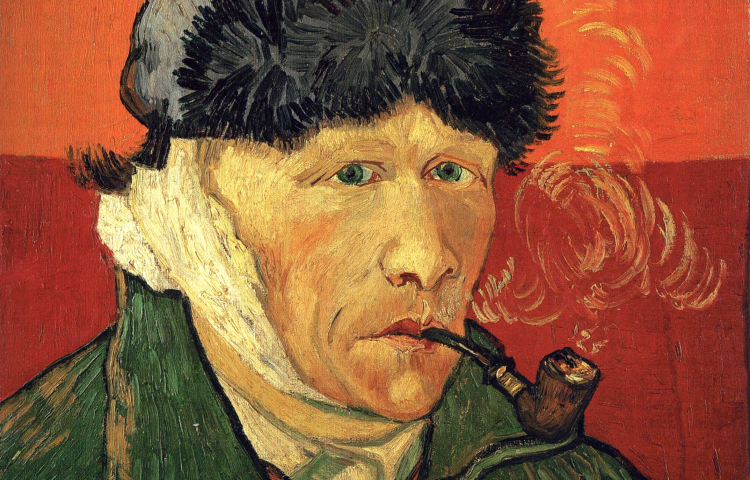
Some artists are better-known for their private lives than their paintings. Vincent Van Gogh straddles that line: His work was famously almost completely unknown during his own lifetime, but now details about his work and private life are devoured by art historians and fans alike. But if you’ve ever heard anything about Van Gogh’s private life, it’s likely related to one of his body parts—his ear.
The story goes like this: Suffering from a bout of some undefined mental illness, Van Gogh got into an argument with a visiting friend, Paul Gauguin. Near Christmas 1888, Van Gogh threatened Gauguin, brandishing a knife and then cutting off a portion of his own ear. He later gave the ear (or part of it) to a prostitute in Arles, telling her to “keep this object carefully.” Indeed, one of Van Gogh’s most famous self-portraits shows him with a bandaged ear, and art historians and even psychologists have spilled plenty of ink trying to understand why he engaged in such a desperate act of self-mutilation while living in Arles.

But is that the entire story? Some art historians beg to differ. They say that what others call “Van Gogh’s mutilation and alienation,” which led to a bout in a mental institution, was actually the result of a duel between Van Gogh and his visiting friend, Paul Gauguin. In 2009, a group of German historians argued that Gauguin actually attacked his friend in a drunken brawl.
The story is certainly possible—Gauguin was both a fencer and an alcoholic who was known for his bad temper. Van Gogh even wrote to Gauguin in early 1889 saying that he would return his friend’s fencing equipment, which suggests it was with him in Arles. But just because the painter was hard to live with doesn’t mean he would injure his friend with a sword. However, Hans Kauffmann and Rita Wildegans conducted a decade-long investigation into the Van Gogh ear incident and feel so strongly that Gauguin was responsible—and that his friends covered up the unfortunate incident—that they published a book about it.
Even if Van Gogh didn’t cut off his own ear, his mental illness was certainly profound. “One feels as if one were lying bound hand and foot at the bottom of a deep dark well, utterly helpless,” he wrote about his own depression. And though there are controversies about just how Van Gogh’s life ended, it’s widely agreed that he committed suicide when he was just 37 years old.