The crowd leaned in as the world’s most famous female pilot took the stand at a special hearing of the House of Representative’s Committee on Science and Aeronautics. It was July 17, 1962, and Jackie Cochran was about to deliver a stunning blow to women’s chances at participating in the United States’ fledgling space program.
“There is no shortage of well-trained and long-experienced male pilots to serve as astronauts,” testified Cochran. “Men come first…[Will women] speed up, slow down, make more expensive, or complicate the schedule of exploratory space flights our country has undertaken?” Cochran conceded that women might be proven to be as fit as men when it came to space exploration, but hesitated at allowing them to participate now. Why not invest in a training program for women who aspired to be astronauts (after taking attrition for things like marriage and childbirth into account)?
At least some people in the audience were stunned by Cochran’s words. Didn’t she realize that she was at a hearing about just such a program…a program she had helped fund?
The story of the Mercury 13, as they became known, began with a researcher who helped develop rigorous test for NASA’s male astronauts. William Randolph Lovelace II became curious about how women would withstand the same tests, so he invited an accomplished pilot named Geraldine “Jerrie” Cobb to take them, too. Under the auspices of a private research program, Cobb and Lovelace found nearly twenty other women, all long-time pilots with over 10,000 hours of in-air experience, to take the tests, too. Thirteen of them passed—and Jackie Cochran paid for their expenses.
The 13 women, known as Fellow Lady Astronaut Trainees (FLATs) endured a brutal set of examinations that measured every aspect of their physical, mental, and intellectual well-being. From ice water being shot into their ears (a vertigo test) to swallowing rubber tubes (a test of stomach acids), the tests were exhausting, intimate, and even humiliating. Still, inspired by the possibility of going to space, the women were enthusiastic. They were told that there would be additional testing on military jets at a future date in Pensacola, Florida. Two of the women even quit their jobs in order to attend.
But as they prepared to prove themselves, the Mercury 13 were devastated to learn that Lovelace had been denied the right to use Naval facilities for additional tests. It seemed that NASA was unwilling to give a thumbs-up to the unofficial program, despite its promise. Irate, Cobb flew to Washington, D.C. to try to get the program to move forward. Finally, special hearings were called to determine whether NASA was discriminating against women—hearings that preceded the Civil Rights Act and Title VII by two years.
Cochran’s betrayal wasn’t just confusing (she herself had fought for women’s participation in World War II and was the first woman to break the sound barrier). It reflected attitudes of its day toward the idea of women in space. She was joined by astronauts like Scott Carpenter and John Glenn, who argued that women just weren’t fit for space flight—yet. The hearing was rife with sexual innuendos and crude jokes. It’s even been reported that NASA’s Manned Spacecraft Center director, Robert Gilruth, told colleagues that NASA was all for women in space—after all, they had reserved 110 pounds of payload for “recreational equipment.”
A day after Cochran’s testimony and a day and a half before the hearings were scheduled to conclude, Congressman Victor Anfuso of New York called them to an end. He had all the evidence he needed—and since women couldn’t join the military and complete the required military testing, they couldn’t join NASA. The Mercury 13 would not be allowed to prepare for space flight.
1995 Photo: NASA From left: Gene Nora Jessen, Wally Funk, Jerrie Cobb, Jerri Truhill, Sarah Rutley, Myrtle Cagle and Bernice Steadman.
In fact, it would be 20 more years before an American woman went to space. And the tests that Lovelace had so daringly conducted in the 1960s only resulted in one scientific study—one that “proved” that women’s tendency to menstruate meant they were unfit for space flight of any kind.
One year after the hearings, Russia sent Valentina Tereshkova on the Vostok 6 mission; she became the first woman in space.
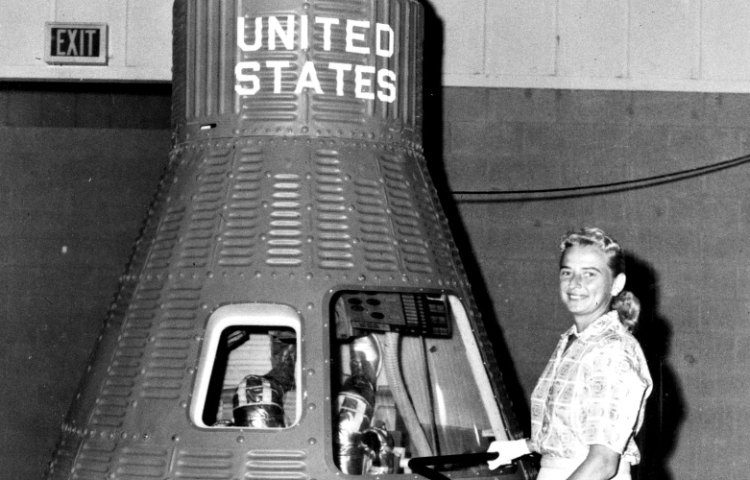
Image: Jerrie Cobb with a Mercury Caspule