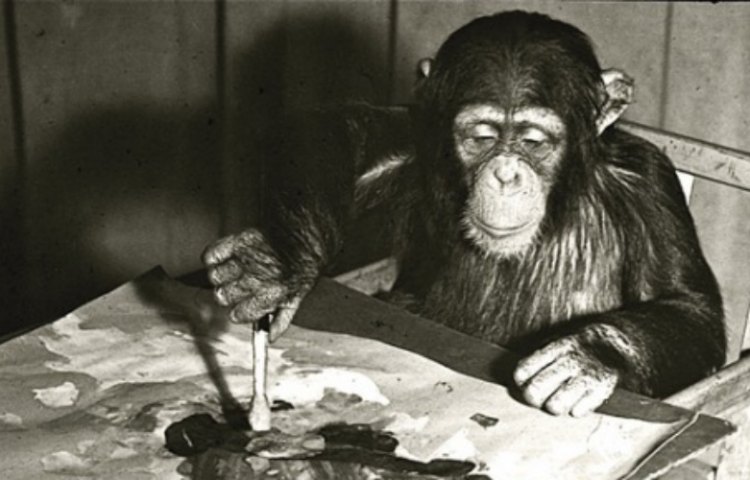
Back in 2005, at an art auction at the upscale London clearinghouse Bonhams, a relatively unknown artist managed to outsell the works of masterful 18th century French impressionist Pierre-Auguste Renoir and 20th century pop art icon Andy Warhol alike. In fact, this artist’s paintings sold for 20 times their estimated value—three items going for $26,000 to an American collector named Howard Hong. The artist himself was long dead, but even if he weren’t he probably wouldn’t have been able to appreciate the intense respect his works had gained over fifty years. Because this artist was not a human, but a chimpanzee named Congo.
Chimpanzee Congo
Raised in London under the care of British eccentric, abstractionist painter, zoologist, and television presenter of Zootime Desmond Morris, Congo (born 1954) began painting at age two when handed a brush and paper to play with. Morris noticed, though, that rather than fling paint about or scribble manically, Congo gripped his brush with purpose, knew instinctively how to balance a sketch, and painted with intentional, radiating patterns, screaming if a painting was taken away before he was done. Exhilarated, over the next two years Morris facilitated the painting of 400 works by Congo, most in a lyrical abstract impressionist style—smudges of ink and minimalist renderings that reminded some of the simpler works of Wassily Kandinsky. After showing his works on air for some time, Morris convinced London’s Institute of Contemporary Art to hold a showing of Congo’s works in 1957, drawing a great deal of attention.
Before his death by tuberculosis at age ten in 1964, Congo had already been praised as the Paul Cézanne of the simian world. He was so admired that some even tried to create forgeries of his works. Salvador Dali declared his hands human, while Joan Miró reportedly traded two of his works for one of the ape’s. And even Pablo Picasso, who supposedly received one of the chimp’s works as a gift, hung the work in a place of pride in his home. And even skepticism and critics had to admit that his intention, focus, self-motivation, and progressive development of style pointed to intentional and brilliant work, causing much hand wringing about the meaning of art and nature of humanity. Granted, there were a few problems with his style—a narrow range of flourishes and strokes, and a reliance on the colors and papers Morris provided. But even with these minor flaws, Congo still managed to blow a serious hole in the art world.
Congo’s not the only primate artist the world’s ever seen. The Mayor Gallery in London has actually hosted an entire show on ape artists of the 1950s like Betsy the chimpanzee of Baltimore and Sophie the gorilla of Rotterdam, The Netherlands. And just this year a Houston zoo found an art-obsessed orangutan. But most of these simian savants’ works are used in tests to see if one can tell the difference between abstract and ape art, to discern primate intelligence, and to pawn off as novelties. There’s a reason, in other words, that Congo’s works were the first ever sold by a non-human at auction, as far as Bonhams is aware.
In some ways, though, we really shouldn’t be surprised that the ape world was able to produce a world-class artist. Over the past half decade alone, we’ve made a host of discoveries proving that chimpanzee culture especially has grown large, complex, and sophisticated—to the point that we might want to keep our eyes out for Dr. Zaius-type characters coming out of their communities. We’ve become aware, for instance, of a 19,305 square mile mega-culture of giant chimpanzees in the Congolese jungle, once thought to be mythic. These apes appear to attack humans who encroach upon their territory and use constructed spears and tools to hunt and patrol, possibly even subduing other tribes and downing jungle cats. We’ve even made some progress as of this year at understanding their simple but sophisticated language. If anything, Congo may just be proof that an aptitude for art and representation comes with the territory of civilization. Or, you know, it may be a dystopian portent of things to come when the apes rise.