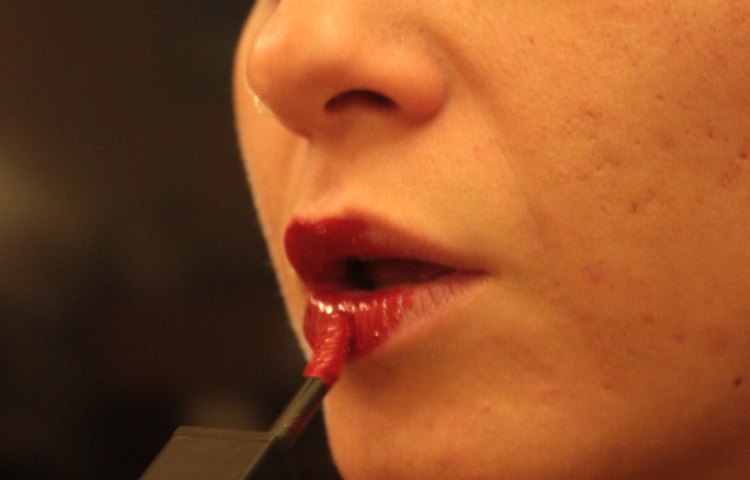
If you wear red lipstick today, the bad news is you’ve probably been smearing pulverized insect carcasses and fish scales across your lips without even knowing it. The good news is that it could be a lot worse—and it definitely was for women in ancient civilizations.
Roughly 5,000 years ago, Mesopotamian women were the first to experiment with lip color. This comes as no surprise; women in Mesopotamia, located in modern-day Iraq, Turkey and Syria, were considered equals alongside men in a culture credited with landmark inventions, including a little thing called, “the wheel.” These innovative ladies crushed up semi-precious gemstones to decorate their lips and eyes.
Wealthy and powerful women like Sumerian Queen Schub-ad, who ruled the Mesopotamian city of Ur in 3,500 B.C., loved their lip paints so much they asked to be buried with their cosmetics next to them, stored in small shell containers. Queen Schub-ad’s desire for the perfect post-mortem pout allows scientists today to identify lipstick ingredients extracted from residue in these graves. The verdict? White lead and crushed red rocks gave this ancient queen her sultry smile.
Mesopotamians weren’t the only people to mistake poison like lead for a beauty regimen staple. Egyptians combined seaweed with iodine and bromine mannite to create lipsticks. Both iodine and bromine mannite can be incredibly toxic. While some sources differ, it’s thought that the phrase “Kiss of Death” originated during this time, as many women who wore these early lip paints became gravely ill. And though she’s more famous for her iconic dark, thick eye designs, Cleopatra is credited with inspiring red, purple and blue-black lip colors made from carmine and crushed beetles around 50 B.C.
Here’s where history experienced the first of many bumps in the lipstick road: As Egypt fell from power and Greece became more influential, lipstick’s respectable reputation began to waver. Instead of remaining a symbol of high social status for both men and women, authorities demoted it the world of prostitution. Prostitutes mixed appalling ingredients like sheep sweat, crocodile feces (yep) and human spit with red wine to make lipstick. Quite the cocktail.
From here on out, people would change their minds on lipstick’s propriety and necessity all the way through the end of the 20th century. For example, throughout the Roman Empire. wealthy women hired (enslaved) the first make-up artists (slaves) to keep royal lips perfectly painted at all times. These women used ochre, lead and vermillion, a deadly mercury-based pigment, to maintain a haute look.
In Europe during the Middle Ages, religious figures declared red-lipped women to be Satan reincarnated, though lily-colored rouges were acceptable for proper girls. In the 1500s, Queen Elizabeth I popularized red lipstick again, which she made with fig milk, egg whites and cochineal, a scarlet dye that comes from cochineal bugs.
For the next several centuries, Europeans would flip flop like this on their views of lipstick and its implications of lady-like behavior. At various times, lip paint on a woman indicated she could be anything from a member of the upper class to a witch, not to mention a prostitute, a married woman, a healer or an actress.
It’s no surprise then that at the beginning of the 20th century in the United States wearing lipstick became synonymous with rebelling against male authority figures in society, government, law enforcement and religion. Lipsticks of the 1920s were made from beeswax, olive oil and dyes, which proved difficult to keep on the lips.
Today, thanks to many safety regulations for cosmetics implemented by the Food and Drug Administration over the past several decades, lipstick is safe to use and easy to transport. A majority of lipsticks currently manufactured contain castor oil, beeswax, lanolin, dyes, perfumes and yes, fish scales. Some of today’s pigments are still derived from cochineal bugs. Some companies use capsaicin, the compound that gives chili peppers their heat, to plump up women’s lips.
Whatever lip color you choose today, remember the millions of women before you who risked health, scrutiny and status to make it possible. And don’t lick it off – unless you want to see what waxy bugs taste like.