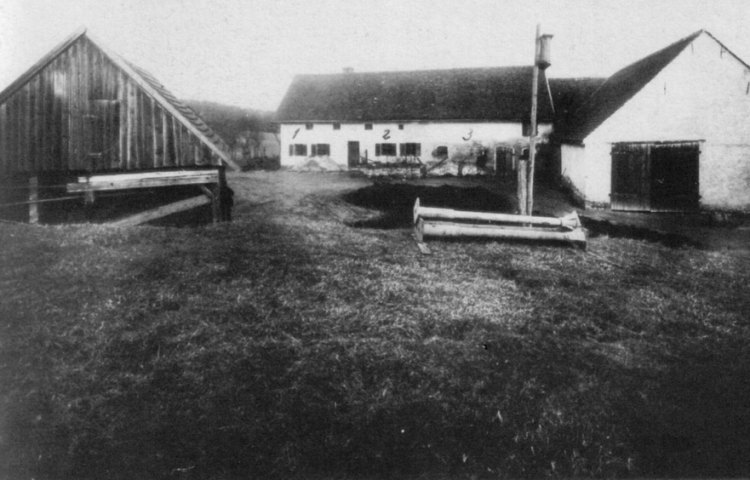
After checking in on the home of seven-year-old Cecilia Gabriel who had failed to show up to school, the small town of Hinterkaifeck, 60 miles outside of Munich, was shaken to its core when they discovered Cecilia, her mother, grandparents, baby brother and maid brutally murdered in their own home. Now known as the 1922 Hinterkaifeck murders of Germany, the murders remain an unsolved mystery peppered with terrifying clues that baffle crime experts to this day.
It is almost impossible to know exactly what happened at the farm on that fateful day of March 31, 1922, but the scene of the crime was unquestionably grisly. The victims—Andreas and Cazilia Gruber, their widowed daughter, Viktoria Gabriel and her two children, Cecilia and Josef, and Maria Baumgarten, the new maid who had arrived that morning for her first day of work—were found pickaxed to death and beheaded. In the barn, Andreas, Cazilia, Viktoria and Cecilia’s bodies had been stacked on top of one another. Inside the home, Baumgarten’s body was place on her bed, and Josef the two year old, was found, skull smashed, in his crib. All of the bodies were covered either with blankets or clothes.
Besides the crime scene, the rest of the story is mere assumption and educated guesses. Authorities believed the family members were led to the barn one-by-one to their deaths. They also believe that since the young Cecilia had torn out tuffs of her own hair, she had been alive hours after the assault until ultimately dying.
Autopsies revealed that the deaths took place on March 31, but neighbors’ accounts of the farm in the last week didn’t add up to the timeline of the Gruber family deaths. After March 31, locals saw smoke rising from the chimney and police noticed that food had recently been consumed. Also, the cattle were fed, and the dog was safely tied up in the barn. Shockingly, the observations reveal that the killer was probably hanging around the house for a few days after the murders.
It’s pretty haunting to think of somebody killing an entire family and then staying around to play house for a bit, but it’s even more chilling to learn that the killer might have been in and around the house before the murders as well. Andreas Gruber reportedly confided to neighbors that he had found mysterious footprints in the snow leading into his farm, but he had not seen any going back into the woods. He also claimed to hear noises in the attic. In fact, the former maid quit because she had heard noises in the attic which led her to believe the farm was haunted. Andreas then discovered a newspaper that he did not buy sitting on his porch. Soon after, a pair of house keys went missing. Though he never reported this to the police, he did tell his neighbors to see if others were experiencing similar strange occurrences.
The other blatant mystery of the Hinterkaifeck murders is motive. It didn’t appear to be money since nothing was stolen from the house. But rumors definitely circulated that it could have something to do with Andreas and his vile reputation—according to word of mouth, Andreas beat his wife and had an incestuous relationship with his daughter, Viktoria. He was supposedly so obsessed with Viktoria that he forbade her from marrying their neighbor, Lorenz Schlittenbauer. Viktoria claimed that Schlittenbauer was her son’s biological father, so Andreas’s objection to this marriage fueled rumors that Viktoria’s son was actually fathered by her own father.
Rumors of incest and jealousy led investigators to suspect that the crimes were a crime of passion, possibly a suitor of Viktoria’s, or Schlittenbauer himself. Another Viktoria-related theory was that her husband, who was reported dead in World War I but whose body was never found, was alive and seeking vengeance on his wife who had a child with her father. That theory was very popular at the time, however, it has zero evidence to back its claim.
Trying to piece together what happened and why, authorities questioned a whopping 100 people over the years following the case, but not a single arrest was ever made. Schlittenbauer was a leading suspect for a while due to his strangely calm demeanor while leading the search party through the house. But ultimately, it was a dead-end.
In 2007, a group of students at the Munich Police Academy were handed the case to solve using modern technology. They deemed the case unsolvable due to the fact that there is such a lack of concrete evidence that stands the test of time. For example, shortly after the original crime, the beheaded skulls were sent to Munich for further investigation but were lost amid the chaos of World War II. Despite the lack of evidence, they were able to narrow it down to one suspect, but have not released his name out of respect for his living relatives. We can only wonder.