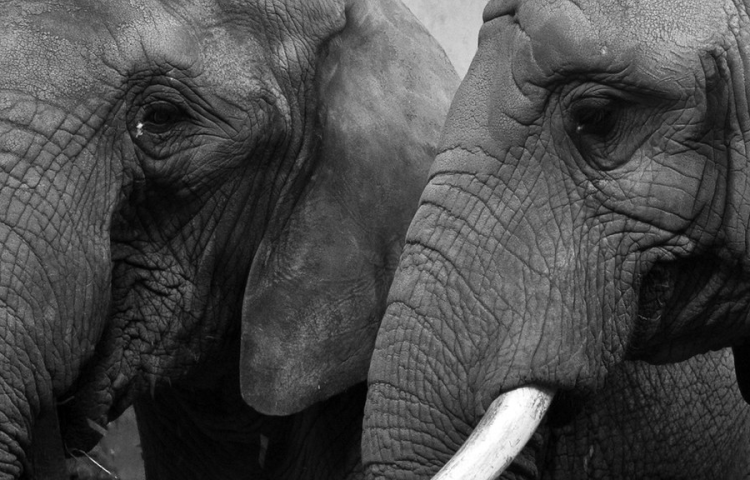
Elephants are huge. Based on the sheer number of cells that make up their bodies—about 100 times more than humans—and their long lifespans, we should be seeing much higher rates of cancer in these multi-ton animals.
That’s how cancer works, after all. One cell goes rogue, and it replicates a militia of unregulated minions. So the more cells an animal has, the greater the potential is for one to slip into a cancerous state. By that logic, elephants should be extinct by now. But they’re not. A study published today in Journal of the American Medical Association has not only confirmed that elephants are less likely to die from cancer, but it also points to why and how it can help us not just fight, but prevent cancer in the future.
Led by researchers at Huntsman Cancer Institute, and including researchers from the Ringling Bros. Center for Elephant Conservation, the study found that the mortality rate of elephants from cancer is less than 5 percent. Compare that to the human ranges which falls between 11 to 25 percent. How is this possible? Well, elephants are just a lot better at killing cancerous cells before they have the chance to replicate. That is, of course, on the genetic level. Humans have two variations, or alleles, of p53, a gene that helps in the suppression tumor formation, which explains why we’ve been able to get this far without being completely wiped out by cancer. Elephants, however, have 38.
Elephants have evolved to be like genetic ninjas when it comes to responding to damaged cells before things get dangerous. That advantage helped the elephant survive and thrive. But they’re not the only large, long-lived animals with evolved cancer resistance mechanisms. Dr. Joshua D. Schiffman, a pediatric oncologist at Huntsman Cancer Institute at the University of Utah, and co-senior author of the study, told Modern Notion that the bowhead whale, which can weight up to 60 tons, is also resistant to cancer. The mechanisms researchers believe these whales utilize are different from the extra p53 found in elephants, but it still shows that, as Schiffman explains, “Throughout evolution, various species appear to have developed unique approaches to avoid cancer.” (And maybe you’ve even heard that sharks don’t get cancer, but it really hasn’t been as proficiently studied as the well-traveled “factoid” would imply.)
So what about us? Unfortunately—and probably from what you can glean from your own experience with cancer—humans are less evolved in that way. And because of that biological shortfall, we’ve been dealing with cancer by killing it after it becomes cancerous. The treatments can be harsh, with lots of painful side effects. If we take a note from elephants, stopping cancer before it begins might be the best cure.
No disease is definitely better than a deadly one, which is why Dr. Schiffman foresees an approach to cancer that aims to prevent it rather than treat once it occurs. That could mean the development of drug that mimics the p53 in elephants or some type of system that delivers elephant retrogenes to cancer cells. But ultimately, Dr. Schiffman says, “Many years of work lie ahead to explore the potential for elephant retrogenes to help treat or even prevent cancer.”