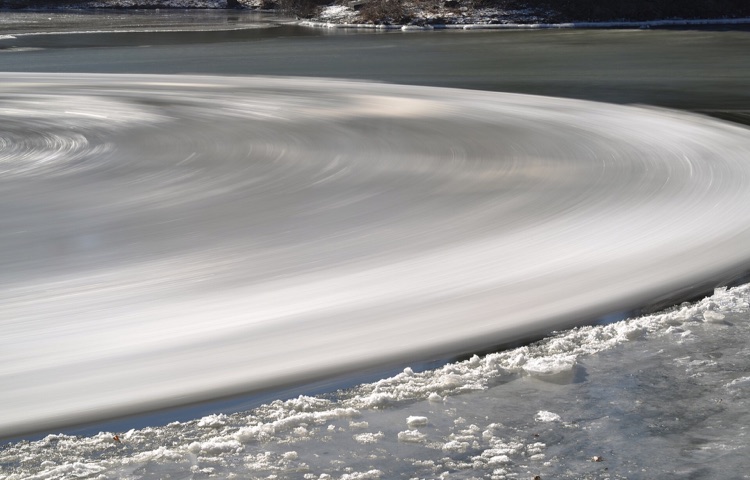
As winter ice spreads across the northern parts of the planet, strange circles will start cropping up on the icy surfaces of rivers around the world—as if aliens had touched down there and eerily left their mark. But what are these shapes and how do they form?
They’re called ice circles, and although it’s tempting to believe they’re either a sure sign of supernatural forces, or are carved out by human hand, they’re actually the by-products of a fascinating natural process.
In November, one of these giant, icy formations graced a river’s surface in northern Sweden—and it was so big that it made the local news. Another image has been doing the rounds on social media recently, showing an ice circle that appeared on the Salmon River, Idaho, a few years ago. Some of these circular wonders can reach 50 meters in diameter, and they occur mostly in North America, Scandinavia, and in parts of the United Kingdom, like England and Wales.
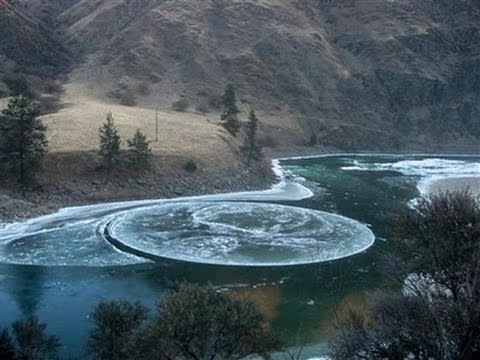 David Vose / YouTube
So how does nature create such precise spheres out of ice and moving river currents? The currents are actually the key factor in this equation.
In a fast-flowing river, swirling eddies form along the outer edges of a river’s bend. These eddies, trapped in the bend, will form an endlessly rotating section of water that can erode away a part of the riverbank. If that happens, the eddy current becomes slower and less powerful at this point. Coupled with freezing conditions, a thin layer of ice can form atop this gently rotating eddy, taking on the current’s spherical, rotating shape.
As the ice circle slowly grows, it reaches the frozen surrounding ice—but the eddy below keeps on swirling, grinding the edges of the circle against the icy layer around it. Eventually, a mathematically precise sphere of ice takes shape, hewn by nature’s forces.
Scientists are still trying to pin down the precise mechanisms that form these stunning phenomena around the world—and as Geo Lounge points out, because of the difficulty of predicting when they’ll occur, it’s hard to study them in the wild. So if you happen to spot a rare icy disk on the river’s surface this winter, take a snap for science.
Meanwhile, here’s a hypnotic video of a rotating ice circle, to keep you entertained.