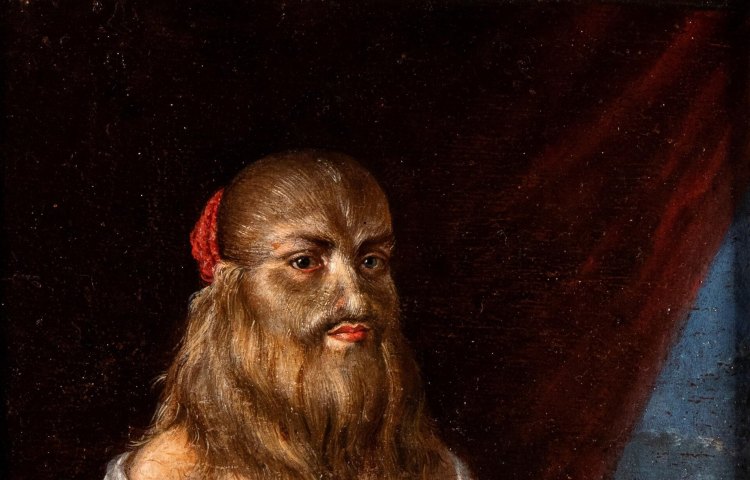
Long before the height of Victorian era freak shows, Barbara Urslerin was already traveling Europe on display for curious, paying onlookers. Urslerin was one of the earliest documented cases of hypertrichosis, or “Wolf Man’s Disease.” The disorder causes rapid hair growth all over the body.
Born in 1629 Germany, Urslerin was the only member of her family with hypertrichosis. Instead of ostracizing her for what set her apart from them, her family capitalized on her “otherness.” As early as 3 years old, they put her in traveling shows, supplementing their income. But no amount of income could make up for how so many perceived and treated Urslerin—like a monster.
But Urslerin was so much more than just how she appeared. She could speak multiple languages and was a skilled harpsichord player. She played for crowds who were fascinated by the dichotomy of an “animal” with such dignified talents. So often compared to dogs, beasts or other animals, Urslerin’s impressive skills were rarely marveled at for what they were but rather taken as proof that she was more human than animal.
As Jan Bondeson writes in The Two-Headed Boy, and Other Medical Marvels, “Urslerin lived during the heyday of the old monster medicine, when scholars and medical men were always on the hunt for marvels and curiosities.” The science community was fascinated with Urslerin, and scholars wrote about her in countless medical journals during her lifetime.
English writer John Evelyn encountered Urslerin many times in his lifetime. He wrote the following description of her in 1657 in his celebrated diary:
The Hairy Maid, or Woman whom twenty years before I had also seene as a child: her very Eyebrowes were combed upwards & all her forehead as thick & even as growes on any woman’s head, neatly dress’d: There comes also two locks very long out of Each Eare: she had also a most prolix beard & moustachios, with long locks of haire growing on the very middle of her nose, exactly like an Iceland Dog: the rest of her body not so hairy, yet exceedingly long in comparison, armes, neck, breast and back; the colour of light browne, & fine as well dressed flax.
Still, there may be an even darker side to Urslerin’s exploitation. Her exhibitions appear to border on prostitution in some accounts. A Frenchman, Elie Brackenhoffer saw Urslerin in Paris and paid her to undress. It is unclear exactly what transpired, but in his travel diary he describes her body in detail and “ascertained” that she was, in fact, a human woman and not an animal. This behavior was encouraged throughout her tours and considered a way for Urslerin to earn a better living:
Motivated by ‘lechery, curiosity, or scientific inquiry,’ visitors were allowed to examine her genitals to reassure themselves that she was woman, as long as they paid an extra fee.
Urslerin went on to marry a man, Johann Michael van Beck, and together they had a child who was not afflicted with hypertrichosis. Van Beck, however, continued the tradition of exploiting his wife, putting her on display as the “Hairy Maid” much like her parents had. Worse, he didn’t tour as her husband, but as her manager, applying to put her up in exhibitions in multiple cities without mentioning that she was his wife. It’s believed by historians that van Beck married Urslerin just to profit off of her marketable uniqueness. Either way, after her appearance in London in 1668, she completely vanishes from history.
It’s heartbreaking to think that Urslerin, at the center of so many people’s curiosity, from side shows to medical journals, just disappeared without a trace. There was never a mention of her death or retirement from the spotlight. It seems most likely that she died in 1668, and no one cared enough to write about it since she was no longer alive to make them money.