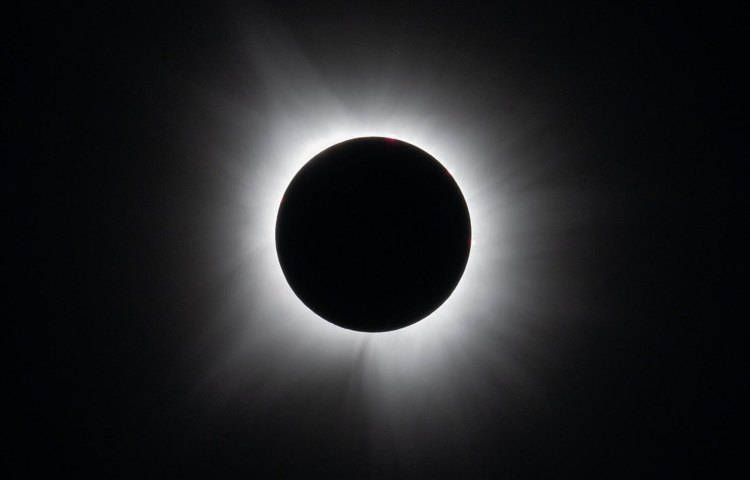
Spain is about to get one of those cosmic scheduling quirks that sounds invented. On August 12, 2026, the Moon will completely cover the Sun just as the day is already coming to an end. The result will be a total solar eclipse that races across northern Spain and then disappears into the Mediterranean sunset.
The eclipse begins far to the north, where the Moon's dark inner shadow, called the umbra, touches northern Russia before sweeping over Greenland, western Iceland and the Atlantic. It reaches the Iberian Peninsula late in the evening, crossing Spain from Galicia in the west to the Balearic Islands in the east. A small corner of northeastern Portugal also slips into the path of totality.
That alone would make August 12 a big deal. Mainland Spain has not seen a total solar eclipse since 1905. What makes this one especially strange is how low the Sun will be when it vanishes. In A Coruña, totality lasts about 76 seconds with the Sun 12 degrees above the horizon. In Burgos, it lasts roughly 104 seconds at an altitude of only 8 degrees. By the time the shadow reaches Palma, the Sun will sit just 2 degrees above the horizon, according to Spain's National Geographic Institute.
Two degrees is not much sky. A hill, apartment building or unfortunately placed tree could block the entire show. Anyone watching from eastern Spain will need a clear view toward the west, and the usual advice to find an open field suddenly becomes more than a suggestion. The reward, if the horizon and weather cooperate, will be the black disk of the Moon and the Sun's pale corona hanging in the warm light of sunset.
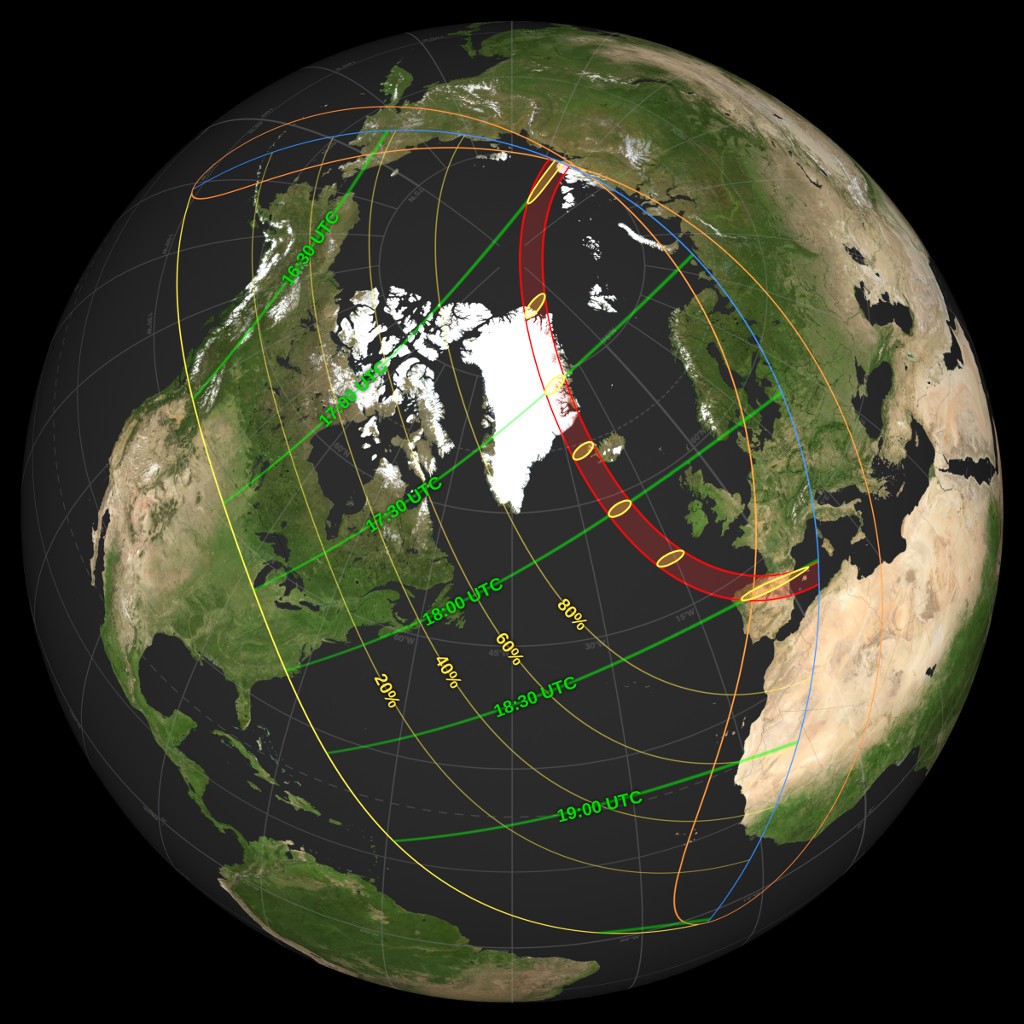 The red band marks the path of totality on August 12, 2026. NASA's Scientific Visualization Studio.
The eclipse will not be limited to Spain. Greenland and Iceland lie directly beneath the Moon's shadow, while much of Europe and northwestern Africa will see a partial eclipse. Canada and the northern United States will get a smaller version of the event. From Alaska to parts of North Carolina, the Moon will appear to take a bite out of the Sun before moving on.
The longest totality occurs near the center of the path around Greenland, Iceland and the North Atlantic, where darkness can last about 2 minutes and 18 seconds. Most people in the path will get less than two minutes. That is not much time, but a total eclipse is not merely a darker partial eclipse. Once the Sun's bright face is completely hidden, the corona appears, the horizon dims in every direction and the temperature can drop noticeably. Then the Moon moves a little farther, the first bead of direct sunlight returns and the whole thing is over.
There is one important catch: regular sunglasses are useless for watching the partial phases. Viewers need eclipse glasses or handheld solar viewers that meet the ISO 12312-2 standard. Cameras, binoculars and telescopes require solar filters mounted over the front of the optics. Only people inside the path of totality may look without eye protection, and only during the brief moment when the Sun is completely covered. NASA's rule is pleasantly simple: if any part of the bright Sun is visible, the glasses stay on.
For everyone outside the path, NASA will stream the eclipse beginning at 1:15 p.m. Eastern time. It will not provide the salt air, the sunset or the frantic search for an unobstructed western horizon, but it also cannot be ruined by a single badly placed cloud.