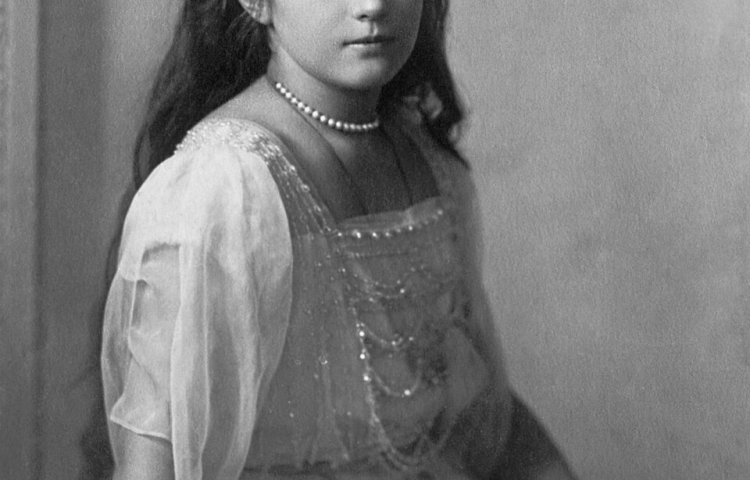
There’s power in wishful thinking. That’s a truth learned (and exploited) by one Anna Anderson, a woman who convinced the world she was really Grand Duchess Anastasia in a time before DNA or reliable proof of identity.
Anastasia was the youngest daughter of Tsar Nicholas II, who disappeared from rule (and the eye of Russia) in the civil war that erupted after 1917’s Bolshevik Revolution. After Nicholas abdicated in March 1917, the entire family was placed on house arrest. It was a humiliating ordeal for the family, who had sunk further and further in public opinion as ordinary Russians struggled with food shortages, rampant inflation, and large number of casualties during World War I. As anti-Communist forces closed in on Yekaterinburg, they went in search of the royal family. But they were gone.
Years later, it became clear that the entire family was murdered at close range by Bolsheviks. But when the world first heard of Anna Anderson, it was still unclear what had happened to the family and to Anastasia, Nicholas’ youngest daughter. Conspiracies raged. Then, in 1922, a patient at a psychiatric hospital in Berlin, claimed that her roommate was Anastasia’s sister, Tatiana. The roommate had been brought to the hospital after a suicide attempt and admitted under a “Jane Doe” name. When an expat who had known Tatiana went to verify her identity, she dismissed it out of hand, calling the woman too short to be the Grand Duchess. But the woman had not said she was Tatiana. People began to wonder if she was Anastasia.
The story got more tangled from there. The strange woman did not speak Russian or look like Anastasia, but again and again she was recognized as the princess. She did not disabuse anyone of their notions. She was removed from the asylum and sent to live with a prominent Russian emigre. Frail and childlike, she moved between houses of prominent Russians who had fled the country, even receiving a travel pass from the city of Berlin that “verified” her identity as Anastasia. As for Anna, she reveled in the attention. “You either believe it or you don’t believe it,” she is said to have remarked about the controversy she seemed to fuel at every turn.
In 1928, she was invited to America by some cousins of Anastasia’s. She even met Anastasia’s uncle, who believed she was the Grand Duchess. But her story began to fall apart when a dispute arose over the estate of Nicholas. Nicholas had disappeared and his death could not be proven, so his estate remained in limbo for ten years before it was released to his relatives. Anna claimed that he had sent money abroad, leaving the Romanov family scrambling for potential money. Angry when it could not be found, they began to denounce her as a fraud. Meanwhile, Anna had been taken in by a rich hostess who was impressed by her supposed credentials. In 1930, she was involuntarily committed for a series of odd incidents including running around naked and killing a parakeet.
Legal battles seemed to follow her wherever she went, as did a hoard of animals and trash. As people attempted to clear up the mystery of the Romanov fortune and disprove Anna’s identity, her mental state continued to decay. She eventually married an eccentric American twenty years her junior and lived with him in a squalid house filled with trash and filthy animals. But it took decades to prove her story wrong. It wasn’t until after Anna’s death and the fall of the Soviet Union that DNA evidence and documents showed that the entire Romanov family had been murdered 73 years before. Her hoax had been tentative and often poorly executed—but intriguing enough to convince people for decades.
Image right: Anna Anderson, Public Domain via Wikimedia Commons