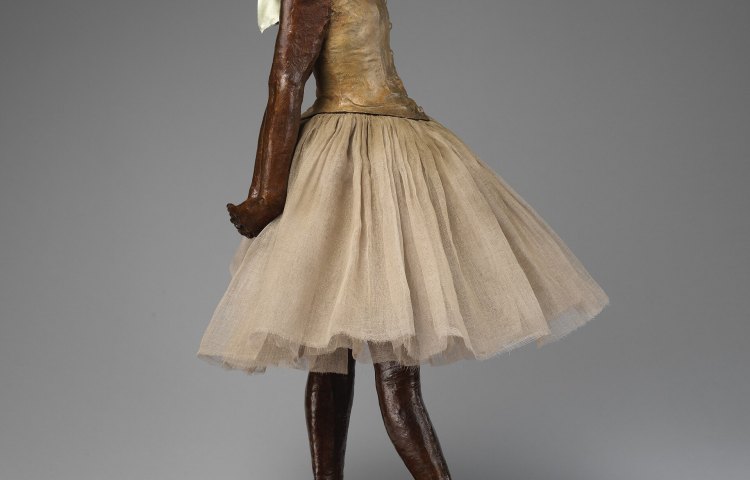
To make it as a professional ballerina it takes an incredible amount of hard work, a lot of luck and a considerable number of resources; like money, access to the right teachers, a ridiculous number of pointe shoes and the ability to travel for competitions, summer programs and auditions. However, despite the privilege associated with ballet now, it wasn’t always that way. In fact, it was a world mostly reserved for very poor young girls who had no other options. Such was the case with the girl behind Edgar Degas’s infamous sculpture “Little Dancer Aged Fourteen,” Marie Geneviève van Goethem.
According to Smithsonian, Degas wanted his sculpture to “portray a young girl who dreamed of having an ‘illustrious life’ in ballet, but who also kept ‘her identity as a girl from the streets of Paris.’” He didn’t have to go far to find that, though, because at the time—according to author of Ballerina: Sex, Scandal, and Suffering Behind the Symbol of Perfection Deirdre Kelly—the Paris Opera was known as the “brothel of France.” Cathy Marie Buchanan, author of the historical fiction novel The Painted Girls, told NPR the girls of the Opera often became mistresses of its wealthy donors because it was fashionable for the men to have a ballerina as a mistress and the dancers desperately needed money as they were paid less than subsistence wages.
Marie and her two sisters—all believed to be dancers at the Paris Opera Ballet School—were the daughters of a laundress and tailor, though it’s believed her mother was really a prostitute as the family lived in “the Bréda district…one of the poorest, most squalid locations for Paris prostitution,” according to historian Martine Kahane. Times grew even tougher when their father passed away, and it seems at least the two oldest posed for Degas multiple times to earn extra money. But it was Marie who would become immortalized in the 1881 two-thirds life size wax sculpture, which today has 28 bronze look-a-likes at museums around the world.
However, like the ballerinas of yesteryear, when the sculpture was unveiled, it did not enjoy the reception it does today. The piece was sculpted out of wax by hand over a two year period, but Marie doesn’t look like a delicate sylph as dancers were usually portrayed, rather as a tired, defiant athlete—or a “girl who looks half-starved and brutalized by life and her profession,” as one critic put it, according to Kelly. Elie de Mont declared in La Civilisation, “I don’t ask that art should always be elegant, but I don’t believe that its role is to champion ugliness. This opera rat has something about her of the monkey, the shrimp, the runt. Any smaller and one would be tempted to enclose her in a jar of alcohol.” Other critics called her “a flower of precocious depravity from the espaliers of the theater,” a “young monster” and “the Opera rat…with all her disposition and stock of bad instincts and licentious inclinations.”
The original statue never sold and Degas hid it away after it’s controversial debut. It wasn’t until after his death that it was cast in bronze and many years later until it became the beloved icon it is today. As for the real Marie, her story is harder to track. Historians say after posing for the sculpture she was promoted from the school to the Paris Opera Ballet’s corps de ballet, but she was soon dismissed for tardiness and too many absences. Sadly, she likely disappeared into the seedy underbelly of Paris without ever having an inkling about the (ironic) inspiration she would one day become to young dancers.