Season four of Game of Thrones went out with an incestuous bang…and a strangling, a shooting, a skull crunch, and a good old-fashioned ear bite. The show not only upped the stakes this season, it adorned them with the heads of many central characters.
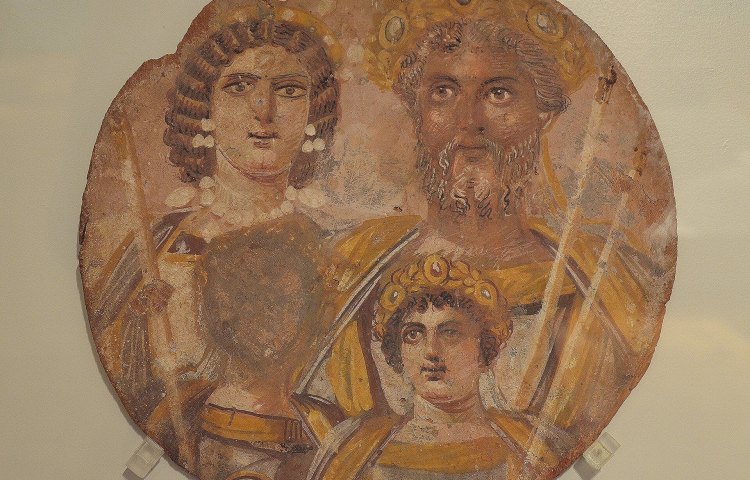
But we’re used to seeing characters drop off like flies, especially after season three’s now infamous Red Wedding. George R. R. Martin often cites the Massacre of Glencoe and the Black Dinner of 1440 as inspiration for this bloodbath at the Twins. But Roman history actually has a much closer analogue to the event than Scottish history: the second wedding of the Emperor Caracalla (188-217).
Caracalla was one of the most unhinged psychopaths ever to rule over Rome, and that is a seriously cutthroat category. This is a man who deliberately arranged to have his brother murdered in front of their mother at a peace meeting. He killed his first wife, randomly purged even his allies, and believed he was the second coming of Alexander the Great.
And in 216, he arranged a real life Red Wedding.
Caracalla had been trying to get into a war with Rome’s longtime rival Parthia, but was rightly getting flak for the pointless campaign. To deflect the criticisms, he offered to marry the daughter of the Parthian king Artabanus V to establish peace between the warring realms.
Artabanus wisely refused at first, but Caracalla persuaded him with either gifts or threats of war, depending on the historian you’re reading. The account I’m going with was written by Herodian of Antioch, a Roman civil servant with Syrian heritage. Though it’s unlikely he was an eyewitness to these events, he was a contemporary of Caracalla’s and recorded the brash emperor’s life story in his exhaustive tome The History of Rome Since The Death of Marcus Aurelius.
According to Herodian, Artabanus was finally convinced of Caracalla’s good faith after many gifts and promises of peace. The Parthian king publicly referred to the emperor as his son-in-law and the Parthians prepared for a royal wedding. Herodian makes special note of the “barbarian” revelers participating in public orgies as Caracalla arrived to take his bride. That almost gives the event a touch of Dothraki charm.
Unfortunately, the “til death to us part” nuptial vow came to fruition faster than expected. “The signal was given,” Herodian writes, “and Caracalla ordered his army to attack and massacre the spectators.” Caracalla’s poor wife, whose name is sadly forgotten, was very briefly the Empress of the Roman Empire before she was cut down by her groom’s men. That’s cold, even for a guy who had his brother torn up in front of his mother.
Several parallels to the Red Wedding are evident right away. There’s the pre-arranged signal, which is reminiscent of the playing of “The Rains of Castemere” and Walder Frey’s ominous last speech to Robb Stark. The Starks and their bannermen were also made to feel safe after observing guest right—a sacred hospitality ritual—with the Freys. Just as they did not expect their host to kill them, the Parthians surely didn’t expect their Roman guests to kill them.
Indeed, in both cases, the attackers leveraged the celebratory atmosphere into a higher death count. “Naturally they did not have their quivers and bows with them,” writes Herodian of the frantic Parthians. “What need for weapons at a wedding?” The observation is similar to Lady Olenna asking what kind of monster would kill at a wedding in “The Lion and the Rose.”
Another similarity is that two high profile targets escaped the bloodshed. Artabanus was rescued by his bodyguards, and lived on to exact huge financial reparations from Caracalla’s successor. Catelyn Stark’s uncle, the Blackfish, also escaped the Red Wedding, having left to drunkenly piss on a tree (his words) before the killing began. Bridal bloodbaths may be an efficient way to kill your rivals, but they apparently still leave loose ends.
We haven’t yet seen Walder Frey’s comeuppance in the show, but I’m happy to report that Caracalla experienced swift karmic retribution. Less than a year later, he was stabbed in the back by his own bodyguard while taking a roadside wiz. He was 29, and mourned only by his gang of thugs and his beleaguered mother, who died shortly after, possibly by her own hand.
Caracalla’s life story would fit seamlessly into Game of Thrones, and it’s odd that Martin has never specifically tipped his hat to it. But regardless of whether it played a role in inspiring the books, Caracalla’s betrayal has the dubious honor of being among the most resplendently dickish moves in recorded history. No doubt the 22nd Emperor of Rome would be quite at home in Westeros.