In 1994, the documentarian Mika Kaurismäki released a delightful little sleeper film entitled Tigrero: A Film That Was Never Made. The movie was about filmmaker Samuel Fuller’s attempt in the 1950s to make a jungle adventure movie based on Tigrero, a book about a man who hunted jaguars. Set to star John Wayne and Ava Gardner, it was ultimately nixed. But what the documentary failed to fully explore was that Tigrero wasn’t some kitschy adventure novel. It was the 1953 autobiography of Sasha Siemel, a hunter, adventurer, and actor-presenter who’s to this day a slow-burn icon in the outdoorsman world—because for much of his life he hunted jaguars for a living with a spear in one of the largest, most dangerous wildernesses known to man.
We know from the many articles about him and from his autobiography that Siemel was born in Riga, Latvia in 1890. He spent his twenties bouncing around the world, moving to America in 1907, then to Argentina in 1909, then to the diamond mines of Brazil’s Amazonian frontier in 1923, working as a printer, mechanic, gunsmith or whatever else was needed at the time.
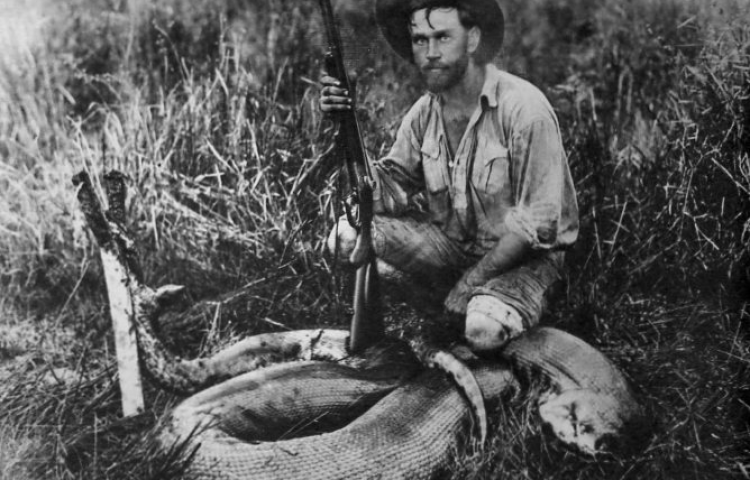
But at the age of 33 the jack-of-all-trades tired of the frontier and for eternally unknown reasons started studying traditional hunting methods with an indigenous man in the Panatal—a tropical wetland the size of Pennsylvania connected to the Amazon and a growing cattle ranching grounds plagued by big predators in the early 20th century. The man trained Siemel in archery and in the zagya, a 7-foot, extremely heavy spear used to hunt large animals like predatory cats. Soon enough he was using his bow to take down crocodiles and his spear to take out jaguars—standing firm while the cats pounced at him, then driving the heavy spear into them. He didn’t do it for the hell of it; instead he offered his services to local ranchers, protecting their cattle. He registered his first spear kill in 1925 (although he also used hunting dogs and rifles from time to time) and soon found himself regular work as a ranch guard and adventure or hunting guide.
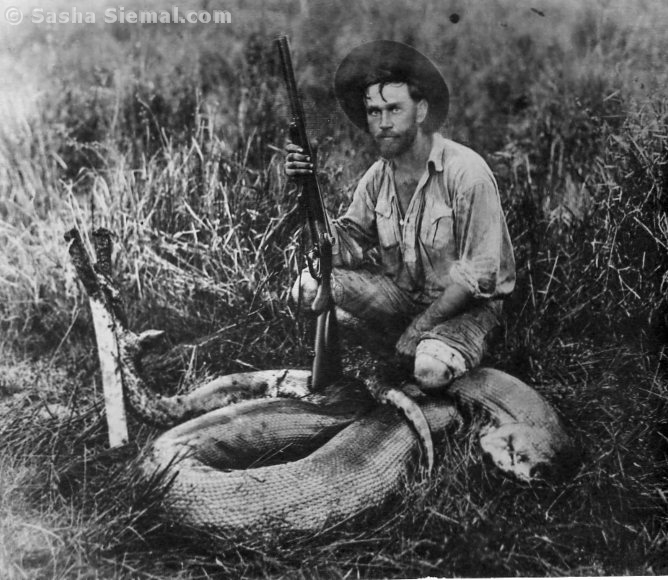
Copyright Sashasiemel.com
Over the course of his career, Siemel would take down about 300 jaguars alone, often using the bow and arrow but scoring 31 kills at least with his spear alone. He was especially well-known for slaying Assassino, the worst-ever menace to the Panatal’s ranchers, accused of killing 300 to 400 cattle. Some believe Assassino may have been the largest jaguar on record, weighing about 350 pounds (versus the average 250 for adults) and measuring in at 10 feet long—an absurd length. And Assassino was a spear-based kill.
But what really secured Siemel’s fame was his service as a guide to the explorer Julian Duguid, who in 1929 asked Siemel to help him cross the Panatal. Impressed with Siemel’s skills, Duguid wrote about him in his 1931 account of the journey, Green Hell: Adventures in The Mysterious Jungles of Eastern Bolivia, as the “tiger man” and the “wild Russian engineer.” The same year, Duguid invited Siemel to the United Kingdom to present to the Explorer’s Club on his method of hunting and the value of the Panatal region.
An instant hit, Siemel started showing up in all sorts of magazine articles—especially after Duguid wrote a biography on him entitled Tiger Man in 1932—both as a thrilling author and subject. Short adventure pieces on Siemel continued to show up until about 2002, when Safari Magazine published the eulogistic “The True Tigrero.” Siemel even briefly became an action star, showing up in the 15-episode serial Jungle Menace as “Tiger Van Dorn” and in the 1946 film Jungle Terror. (He also did a 1952 ad for Puerto Rican Rum for Life Magazine and you can still find CBS footage of him discussing his hunting craft in 1953 in the American Natural History Museum’s archives.) Siemel became such an icon of South American adventure—a genre now eclipsed by the memory of African safari adventure and big game hunting—that he actually became the 10th man to get a Smith & Wesson .357 Magnum, the first ever Magnum firearm (the first registered gun went to J. Edgar Hoover), and buddied up to some of the leading bow hunters and traditionalists in mid-20th century America.
While on a lecture series tour in 1937, Siemel met a young photographer in Philadelphia—a girl from New Jersey named Edith Bray who decided that she wanted to accompany him to the jungle. Smitten with him, she and her chaperon on the trip managed to take down some big game. And by 1940 the couple was married and living in the Panatal, where they eventually had four kids, none of whom fell too far from the tree and at least one of whom, Sasha Jr., became the subject of mass media coverage for his young exploits as a big game hunter in the early ‘60s.
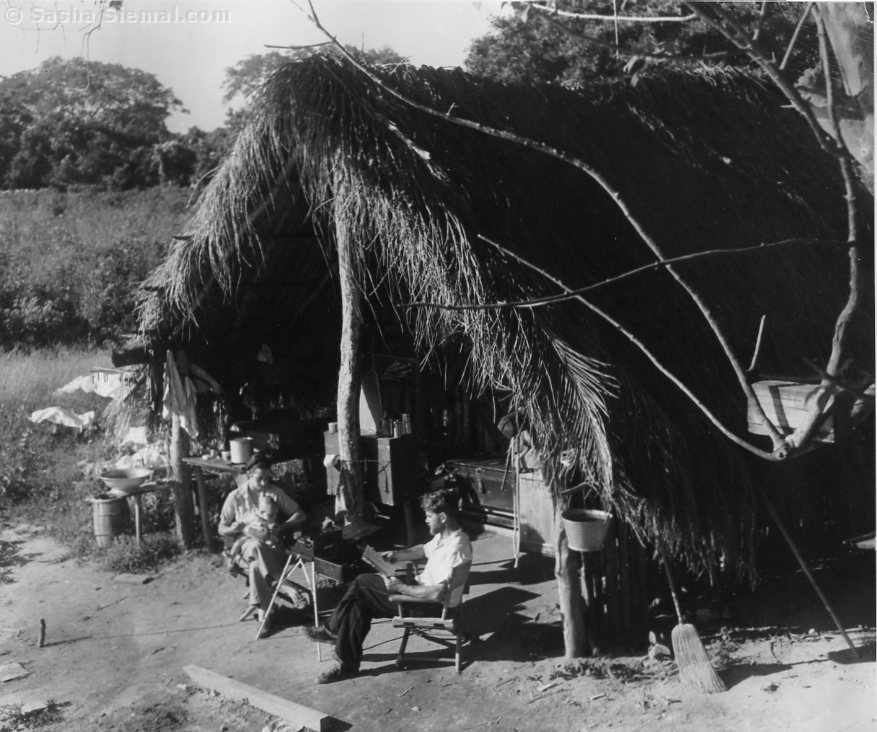 Copyright Sashasiemel.com
After a few years living rough, Sasha and Edith moved to Marlborough Township, Pennsylvania in 1947, purchasing the Bom Retiro farm, from which Siemel would jet out to the Panatal on a regular basis to lead expeditions, but increasingly devoted himself to writing and reflection. By 1953, he’d published his autobiographym and by 1963, he’d assembled enough artifacts of his trip to open a museum in the township all about the Panatal. Apparently over the years he’d become something of an environmentalist as well, realizing that forces like him and larger were endangering the Panatal that he so enjoyed and lobbying fiercely for the preservation of large animals and the wildernesses in which they lived—not uncommon wishes for hunters. He lead his last mission to the Panatal in 1968, then closed his museum in 1969 and died peacefully at home at the age of 80 in 1970; Edith survived him until 2012, dying at 93.
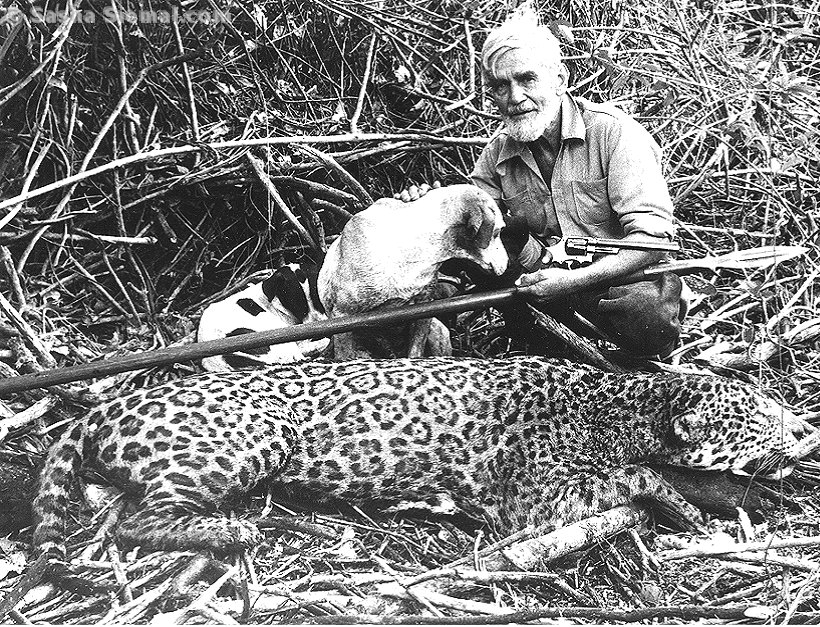 Copyright Sashasiemel.com
Siemel’s family has done a good deal to keep his memory alive, operating a website in his honor and apparently putting together a memorial room in London. But outside of his family, the public may have forgotten the great adventurer. And that’s sad, because in many ways he was the popular ambassador of a region, which is now to us just mysterious and dark. He was a glimmer of old-school adventure and a sign of just how tough and adaptive humans can become. He was a complicated figure who showed the thin lines between roughshod Western adventurers and thoughtful conservators of nature and culture—he showed how those lines blurred into each other all the time. All-in-all he was an exceptional man whose story deserves some kind of telling beyond a movie that was never made—if only because he was clearly such a willful, charismatic, and utterly badass man, with a clear human side too.