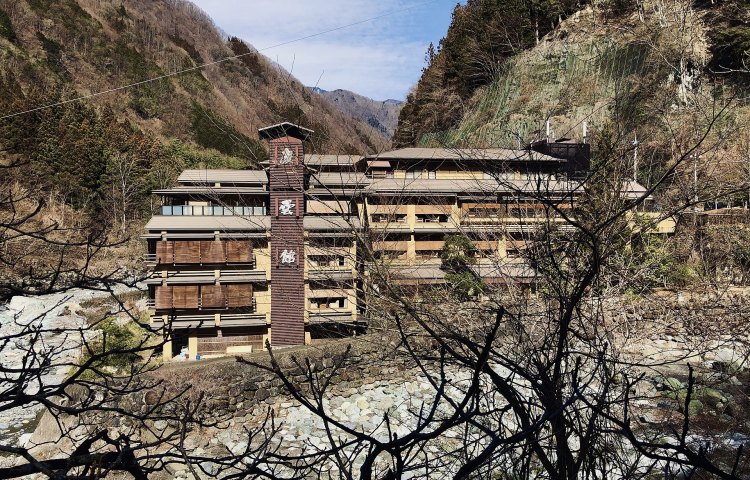
The Nishiyama Onsen Keiunkan, an inn outside of Hayakawa in the mountainous, picturesque countryside of Japan’s Yamanashi Prefecture, wants to be known for its hot springs. A modern, four-star facility, last renovated in 1997 and boasting everything from 37 traditional tatami mat-floored rooms to a karaoke bar to a restaurant serving locally-sourced koshu beef, the swank establishment sits over six natural baths frequented by patrons eager to drop $300 to $650 per night to get away from it all (they don’t have internet). And now, they advertise, they’re trying to distinguish themselves as the hot spring resort with the most water produced per minute, digging a new 888 meter well that gushes out 430 gallons of 126 degree water per minute.
Yet for all that they lean on their waters, Nishiyama already has a claim to fame—a big one upon which it could probably ride if it wanted to. Established in 703 CE by Fujiwara Mahito, son of Fujiwara Kamatari, an aid to the 38th emperor of Japan, Tenji, Nishiyama is officially the oldest hotel in the world. In all that time, from its days as a samurai hangout to its modern incarnation, its been operated by the same family. Currently in its 52nd generation of continuous management, that makes it the oldest business in the world continuously operated by the same owners as well as the oldest inn. And its longevity—and that of many other ancient Japanese businesses—holds simple but meaningful secrets for the smooth functioning of modern small businesses.
By comparison, the oldest hotel in Europe, Zum Roten Baeren in Freiburg, supposedly dates back to 1120. Yet it pales in comparison to the second, third, and fourth oldest inns in Japan, all of which soundly predate it. In fact, six of the world’s ten oldest continually run businesses are in Japan, and 56 percent of the world’s companies older than two centuries are Japanese. (Germany comes in a far second, housing 14 percent of all the worlds two-centuries-old companies). So Nishiyama is far from a fluke—it’s part of a long tradition of age and knack for survival.
As to what the secret sauce in Nishiyama and its peers is, it’s easiest to view it through the fall of what was once the oldest continuously operated family business: Kongō Gumi, a Buddhist temple construction company founded in Japan in 578 CE. During the boom years of the 1980s, the scion of that venerable family decided to expand into real estate, borrowing heavily only to lose on every risky deal and fall deep into debt in the recession of the 1990s. In 2006, a larger construction firm acquired the company, $343 million in debt after its failed bid at growth.
Many believe Kongō Gumi fell because it began to prioritize growth over stability. These same observers believe point out that almost 90 percent of all hundred-plus-year-old companies employ less than 300 people—driving home the point: keep it small and simple, stupid.
For Nishiyama, the ethos seems to be that the hotel can grow, but the family, as much protecting an heirloom as running a company, focuses on what it knows. It helps that, as a hotel, they are a particularly resilient business to begin with—breweries, hotels, pubs, and restaurants tend to be in continual demand, no matter the changes in the world, making them, on average, the oldest businesses in the world. But without their focus on service, patronage, and continual small-scale improvement—like their insistence on developing a new hot spring rather than riding on the reputation of their age for customers—Nishiyama might not have made it this far.
In an era where most companies collapse after just 15 years, it’s worth it for small business owners to heed the simple lessons of Nishiyama and its ilk: Stay small, do what you know, and always focus on developing a strong base of patronage and reputation for excellence. Don’t just grow willy nilly for the hell of it as so many companies—and countries—inexplicably try to do.