In 2013, a Marxist-leftist group claimed responsibility for bombing the US Embassy in Ankara, Turkey and Americans were confused. This (and subsequent lack of substantial news coverage) didn’t stem entirely from our unfamiliarity with the perpetrating Revolutionary People’s Liberation Party-Front. It came in part from the fact that we’re used to seeing suicide bombings part of Muslim terror, and seeing it used by another group challenged a major modern narrative.
This link doesn’t really hold. Sure, suicide bombings are now common in conflicts in the Muslim world, but in the Israeli-Palestinian conflict, for example, the tactic only emerged in 1993. Yet it’s difficult to say exactly where suicide bombings originated, given the fact that we don’t really have any great definition for what combination of intent and weaponry qualifies for the title.
We know we can’t count early suicide attackers, like Zealots of 1st century Judea, the Assassins of 10th century Persia, or the roughly contemporary Crusaders. They all went into battle intending to kill themselves to escape execution or torture, or knowing they would die. But none of them turned themselves into weapons that could only be activated by the loss of their own lives. Suicide bombing (somewhat obviously) could only exist when we had small, triggered explosives—because that allowed the attackers to become the weapons themselves.
Yet some believe a suicide bomber has to act on firm ideology and intend to create a spectacle of indiscriminate terror to be a suicide bomber. But that might more accurately be a definition of terrorism writ large. If we instead take suicide bombing to simply mean that a human acts as a guidance system for a small explosive with the intent of dying in the process, then the practice may originate as early as the late-18th century in Europe, or at latest during World War II.
The first real candidate for the original suicide bomber may be the Polish anarchist who in 1881 publicly assassinated Czar Alexander II of Russia. Having failed to get close enough to the Czar with remote weapons or short-range weapons of sufficient strength, the bomber apparently decided to make himself the sacrificial trigger for a small grenade to complete his mission. Yet since we cannot know that he truly intended to die, we cannot pin the practice on him entirely.
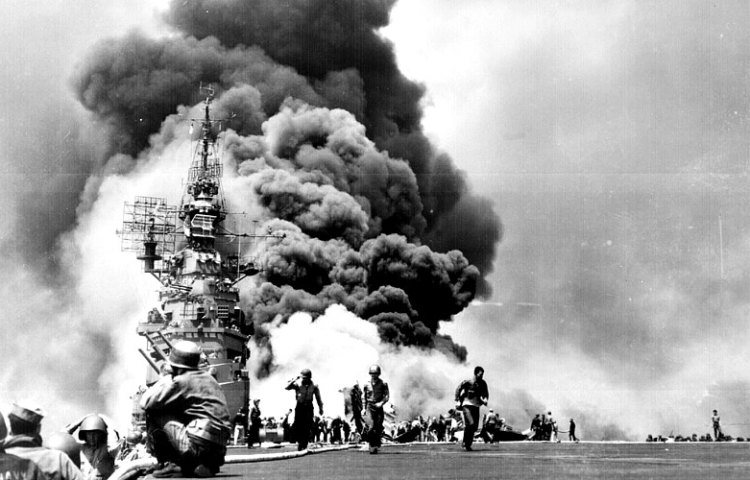
Those reluctant to consider this candidate might be more willing to accept the kamikaze pilots of Japan during World War II, who used their aircraft as explosives to attack their foes. As we know they intended to die in the act, they certainly qualify as suicide bombers (although again, those who think the practice has to involve a strategy of spectacle and terror would disagree).
It was only somewhere between half a century or one century later (depending on which origin one subscribes to) that suicide bombing arrived in the Middle East. In 1981, a member of an Iraqi Shi‘a group drove an explosive’s laden car into the Iraqi embassy in Lebanon in revenge for harsh measures by Iraqi Sunnis against his co-religionists. And it was only in the mid-to-late-1980s that individuals like Osama bin Laden started to use suicide bombings for spectacle and attention—as strategy more than a tactic. Yet even then, Muslims were not the world’s foremost suicide bombings. That dubious honor went to the Tamil Tigers, Hindus (not acting on religious motives) in Sri Lanka, who held the record for most suicide bombings until the new millennium.
Endless ink has been spilt trying to figure out why we’ve come to label suicide bombings a near-exclusive Muslim practice. But rather than getting into that here, the next time we’re confronted with a suicide bombing in the news, it may do us well to recall the long, diverse, and often opportunistic history of the practice, lest we give in to confusion and perpetuate more dubious associations.
Image: USS BUNKER HILL hit by two Kamikazes on 11 May 1945 off Kyushu.