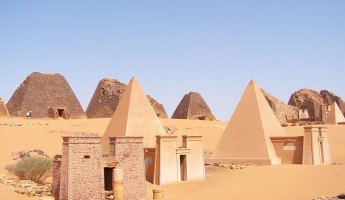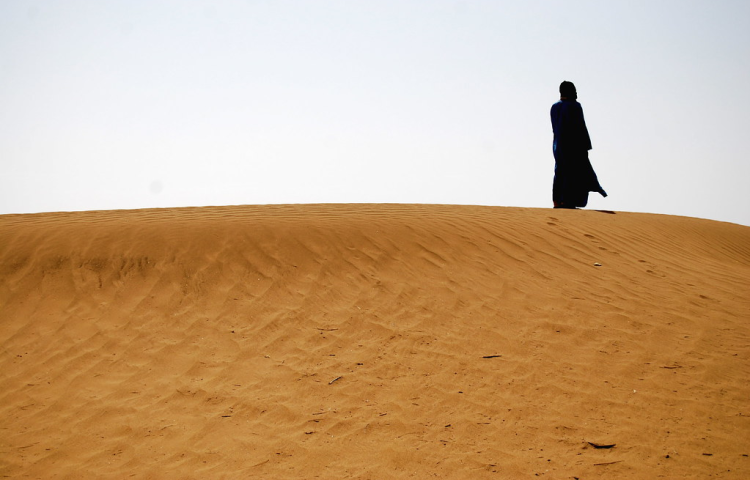
Although we like to think of geography as something fairly constant (e.g. mountains do not move), every year a little more of the world gets eaten away by our ever-expanding deserts. At present, a third of the globe has been claimed by 20 million square miles of inhospitable aridity, but by the end of the century regions like the Middle East could lose up to 20 percent of their rainfall, leaching moisture as dirt spreads through the air desiccating and claiming territory for the sands.
And perhaps one of the hardest hit regions suffering under desertification is Africa, already 40 percent desert, but facing the loss of over half of its arable lands in the near future to dry winds and drier soils. And one of the fastest growing threats on the continent is the Sahara, already a massive desert, which during the 1980s alone crept 145 miles south and 66 miles north—a rate of advance that will only increase with the aridifying effects of climate change.
Yet in the face of this existential threat, African nations have long floated a radical idea to combat desertification: building a giant wall of trees, nine miles wide and 4,831 miles long, from the Red Sea to the Atlantic Ocean, spanning eleven countries (Burkina Faso, Chad, Djibouti, Eritrea, Ethiopia, Mali, Mauritania, Niger, Nigeria, Senegal, and Sudan). First proposed in the 1980s, the Great Green Wall of Africa (potentially the largest horticultural project in human history) would use tree roots to help seed water deep into a region’s soil and canopies to block the advances of dusty and desiccating winds—a simple but highly effective way of preventing desertification.
Originally a pipe dream, the project became a reality in 2011 when the nations involved held a summit to kick off their joint construction of the Great Green Wall of Africa, with each country pledging to find a way to develop its own segment. But given the murkiness of the processes to be used to develop this wall, the diffuse responsibilities, and the scale of the problem, many remain unsure as to whether or not such a program can succeed. Yet there are precedents of massive anti-desertification tree planting projects (and initial results on the African project out of Senegal) that can be used to measure the probability for success of this massive initiative.
Unfortunately for proponents of the Great Green Wall, the biggest previous example of a mass tree planting regimen against desertification is also one of the most disheartening: China’s Three North Shelterbelt Project. Since 1978, the Chinese government has planted tens of billions of trees and hopes by 2050 to have a 2,800 mile northern border defending against the creep of the Gobi desert into already arid farming lands (right up to the edge of Beijing)—a project so massive that it promises to increase the amount of forests in the world by 10 percent. And using poplar trees, with their spider web roots and clonal offspring, they hope to have a wall which grows quickly, and can be regularly harvested to little detriment for things like paper pulp and construction planks.
Yet despite the massive efforts and huge expenditures put into this project over three-and-a-half decades, the levels of desertification the state is fighting have proven too much for these non-native trees, with a survival rate as low as 15 percent for these young-dying colonies, which will need constant and costly replanting and massive irrigation and soil fixing investments to keep in place. That’s a patchy success rate for a program that’s already hard for well-endowed nation like China to keep operational, which doesn’t bode well for similar efforts planned by some of the world’s poorest nations like Burkina Faso, Mauritania or Niger.
Other anti-desertification projects using tree walls have been more successful, such as Israel’s planting of 10,000s of acres of foliage on the edge of the Negev desert, President Franklin Roosevelt’s anti-Dust Bowl Shelterbelt, or even Kenya’s recent Green Belt Movement. Yet in these cases success have via intensive and costly irrigation, incentives for local farmers to change their growing habits alongside the tree planting regimen, and grassroots efforts largely involving ecologically suited (or better yet native) plants, respectively—none of which will be cheap or easy in the rural, fragile, and sometimes lawless zones involved in Africa’s project.
Yet some local reforestation and anti-desertification projects predating the current wall project in Burkina Faso, Mali and Niger give many proponents of the project hope. By convincing locals that they could improve their food security by integrating trees into their farming practices, and relying on grassroots participation and policing, some communities have managed to restore forestation and stop desertification on the cheap over substantial tracts of land.
The existing evidence seems to suggest that Africa can turn back the Sahara’s advance, provided they use the right type of plants and the right style of incentives. Accordingly, global bodies have allocated well over a billion dollars to the Great Green Wall (often as part of larger grants), and Senegal has taken point, developing hundreds of miles of wall for only a few million dollars and creating lists of drought-resistant, native foliage that other nations can use in their own segments.
But if just one nation fails to live up to its promises, it will allow the desert to advance here and there, with domino effects for the ecology of the continent as a whole. And it’s just not clear that organizing tree planting like Senegal has will be as easy or as high-priority for every nation involved. So the downfall of Africa’s Great Green Wall may not be horticultural or technological failures as in China, or a function of the expense of the project as the example of the Negev project would suggest, but just a slow and boring issue of poor international coordination. That’s unfortunate, as it’d be a sad and ignoble death for such a low tech yet promising green solution.